Concepts
Clear explanations of MCP, RAG, agent harnesses, reasoning models, LLMs, diffusion models, LoRA, and fine-tuning.
Every page here follows the same method: explain the mechanism, cite the primary source it's checked against, and say plainly where it breaks down. No vendor pitch, no invented benchmarks — see the sources list at the bottom of each page.
- PROTOCOLVideo
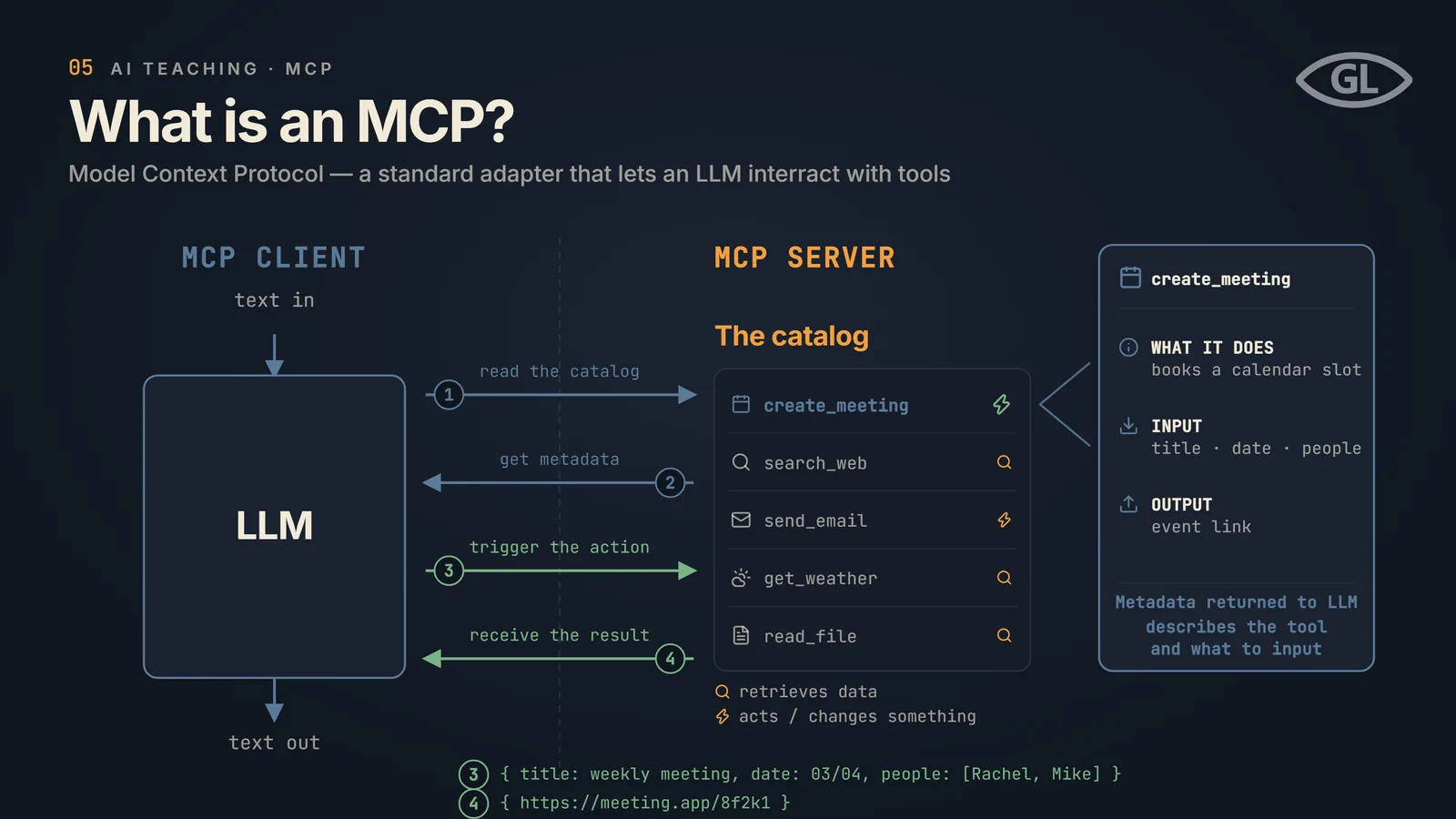
What Is MCP (Model Context Protocol)?
MCP (Model Context Protocol) is an open protocol that standardizes how an AI application connects to external tools, data sources, and systems. Rather than writing a custom integration for every tool a model might use, you implement one interface that any compliant client and server can speak.
- PATTERNVideo
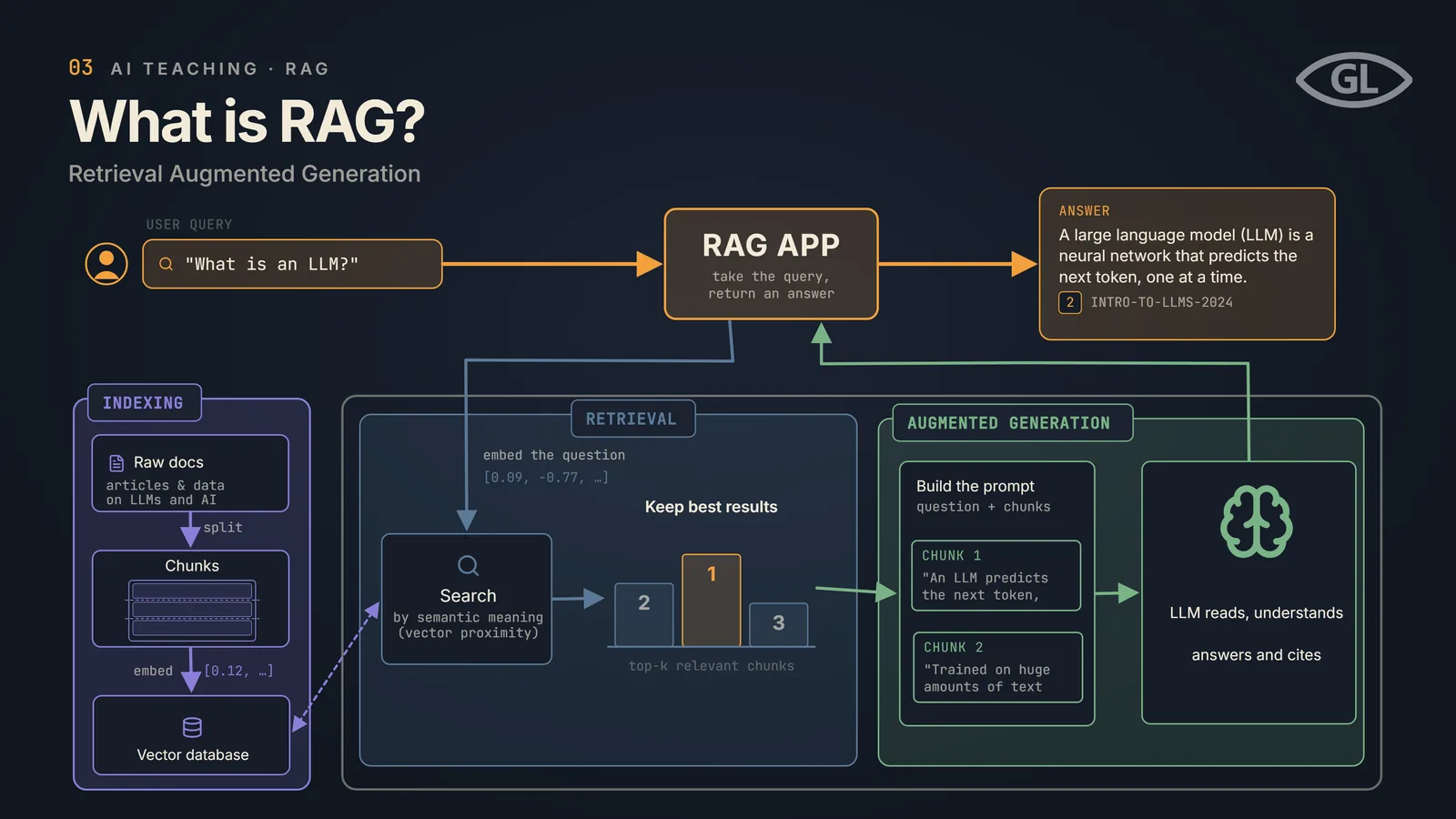
What Is RAG (Retrieval-Augmented Generation)?
RAG (Retrieval-Augmented Generation) is a pattern where a system pulls relevant documents or passages at query time and drops them into the model's context before it answers, instead of relying only on what the model learned in training.
- MODEL TYPEVideo
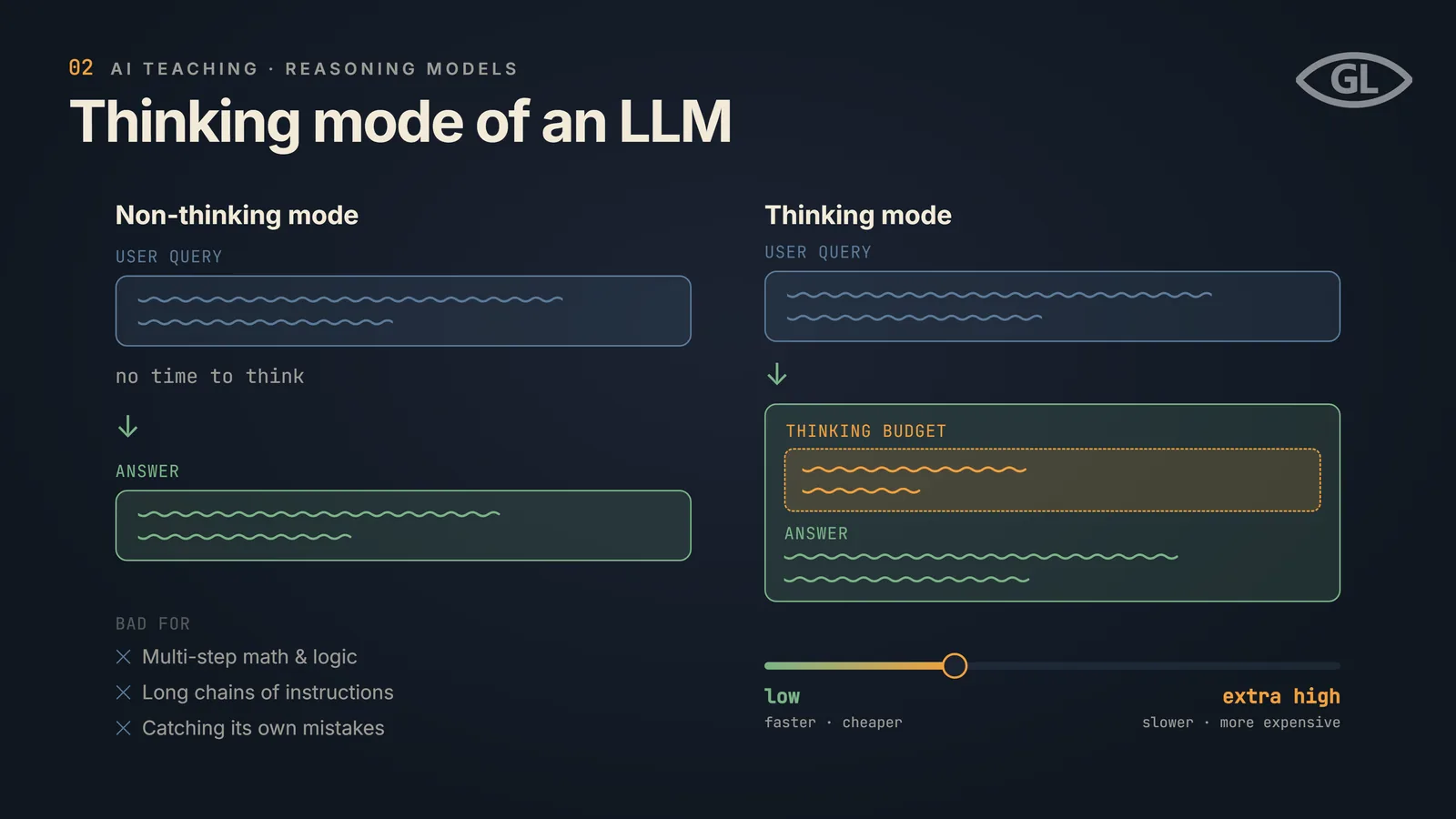
What Is a Reasoning Model?
A reasoning model is trained to work through a long run of intermediate steps before it gives a final answer, instead of replying straight away. That buys better accuracy on tasks with multi-step logic, and it costs more compute and latency per query.
- FOUNDATIONS
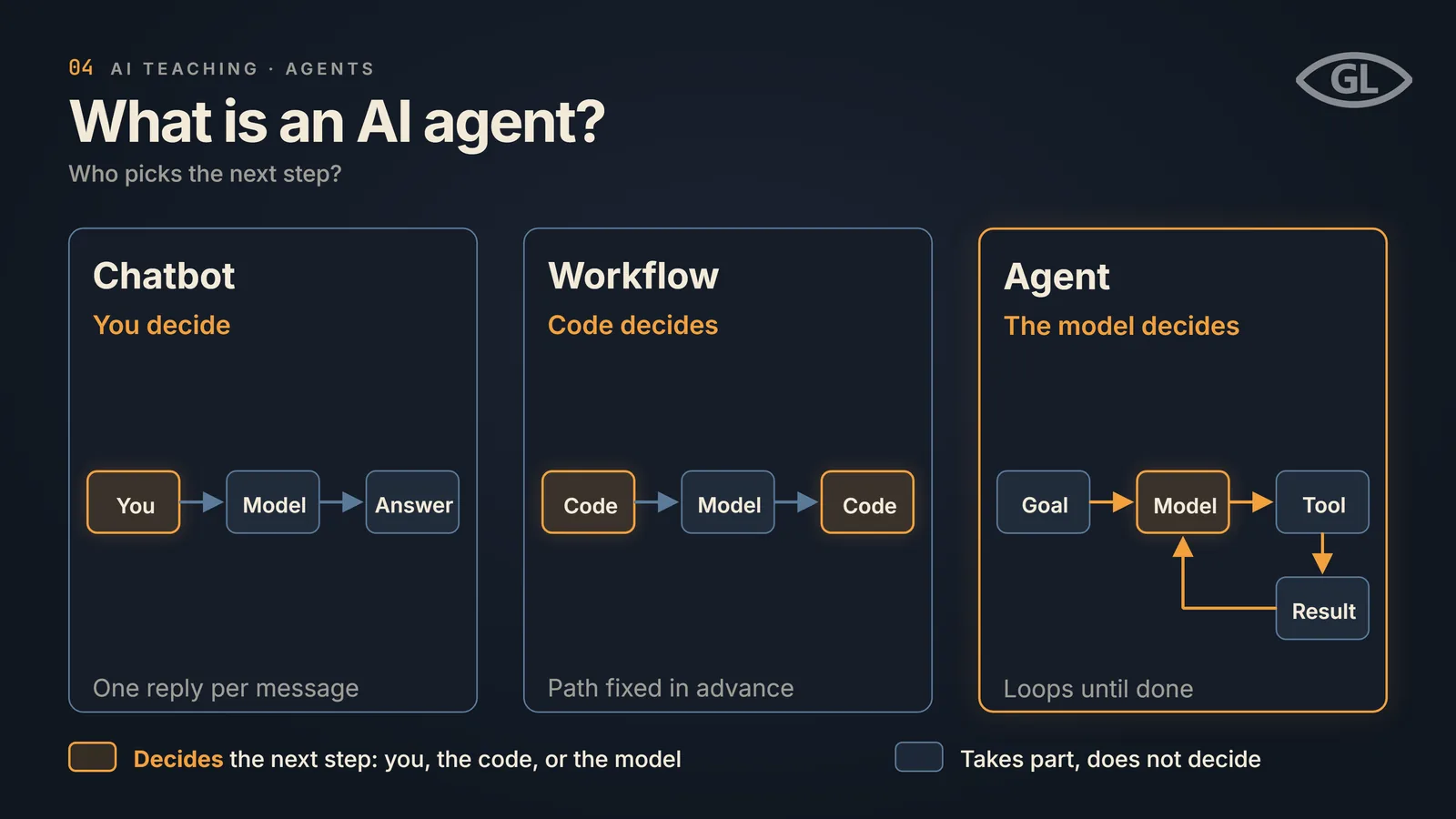
What Is an AI Agent?
An AI agent is a language model that works toward a goal by choosing its own next step: it decides what to do, uses a tool, looks at the result, and decides again until the task is done. A chatbot answers once per message. A workflow follows steps that code fixed in advance. An agent is the one where the model picks the path.
- ARCHITECTUREVideo
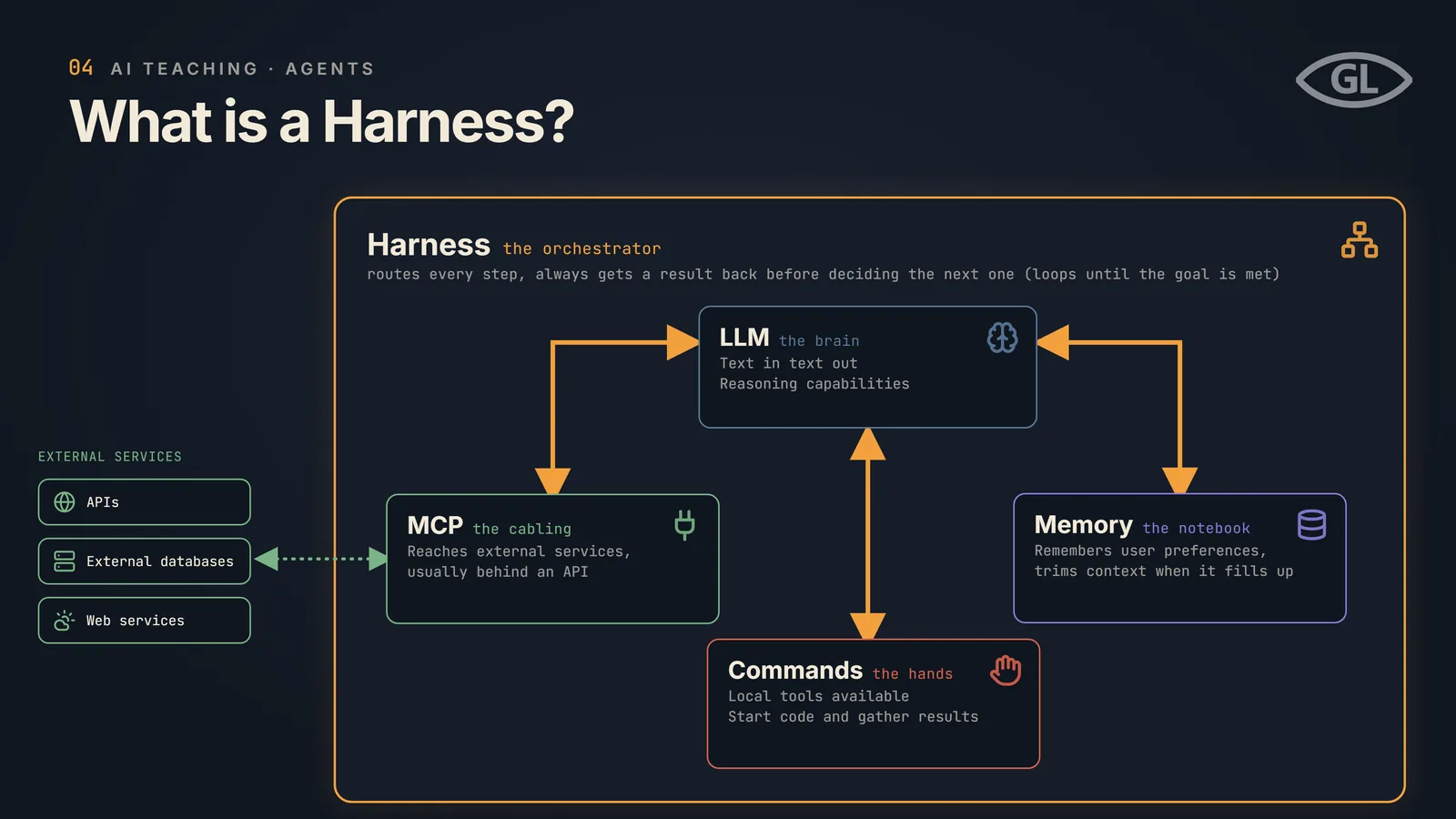
What Is an Agent Harness?
An agent harness is the software around a model that turns it into an agent. It runs the loop: call the model, run whatever tool calls the model asks for, feed the results back, repeat until the task is done. The model brings judgment. The harness brings the loop, the tools, and the guardrails.
- FOUNDATIONSVideo
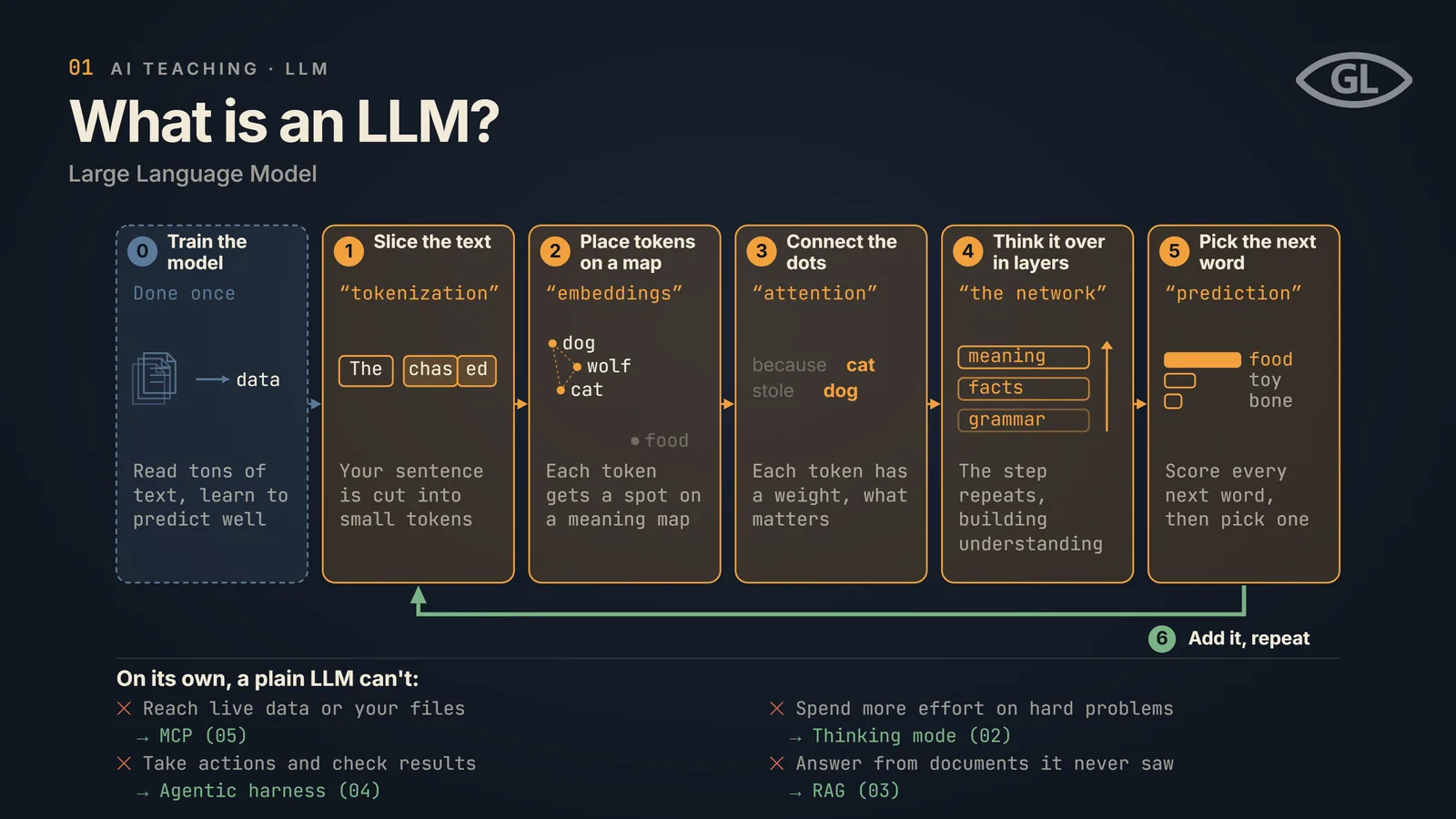
What Is an LLM (Large Language Model)?
A large language model (LLM) is a neural network trained to predict the next token in a run of text, given everything before it. That one training objective, run at enormous scale, is what produces behavior that reads like writing, reasoning, and conversation.
- FOUNDATIONS
What Is a Neural Network?
A neural network is a function made of layers of simple units (neurons), each one a weighted sum of its inputs passed through a small nonlinearity. Nothing about what the network should do is programmed in; every weight is learned by adjusting it against training data until the network's output gets closer to the target.
- MODEL TYPEVideo
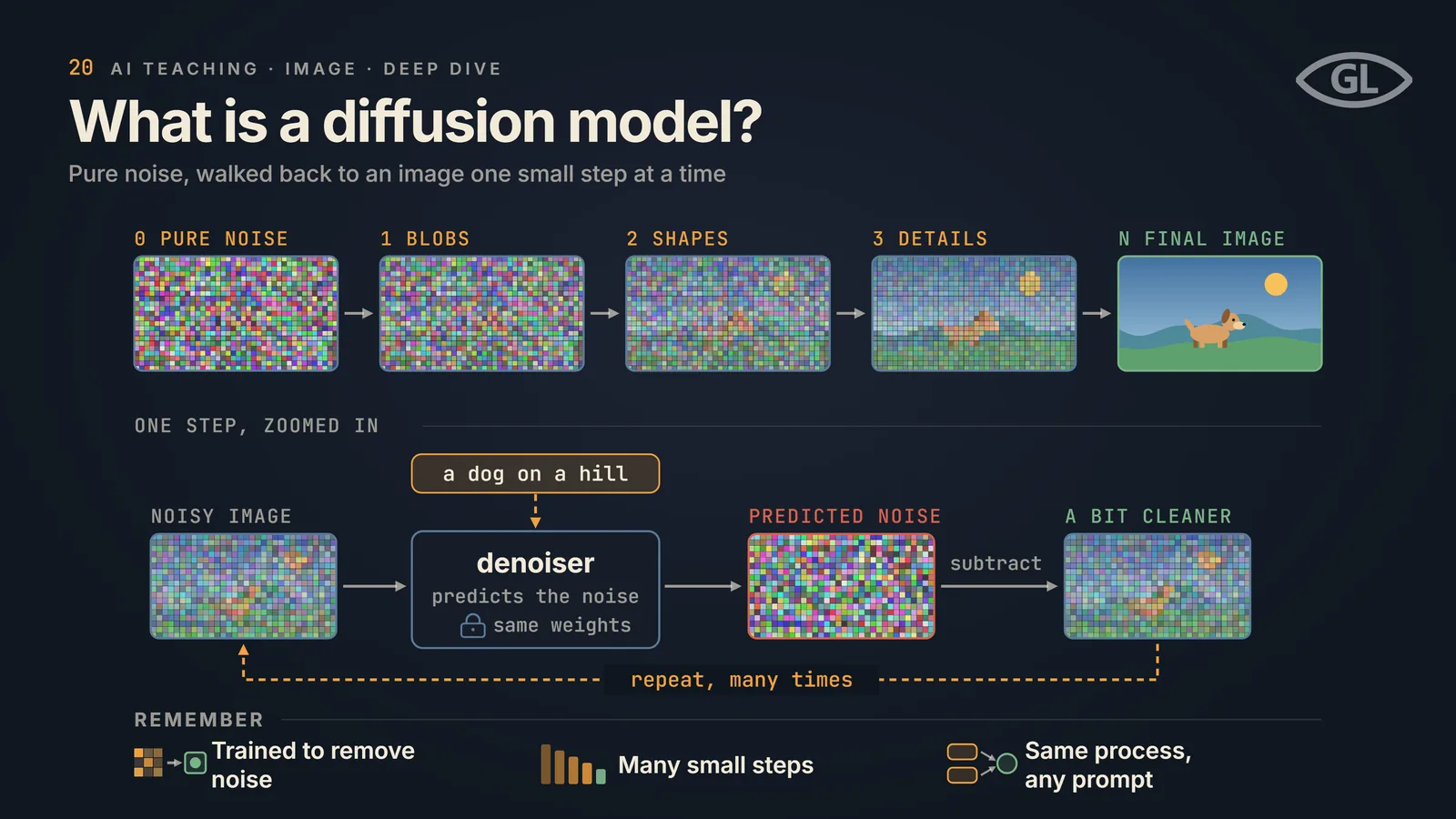
What Is a Diffusion Model?
A diffusion model generates images (or video, or audio) by learning to reverse a process that slowly adds noise to data. Trained to undo that noise one step at a time, the same model can start from pure random noise and walk it back into a coherent image.
- TRAINING TECHNIQUE
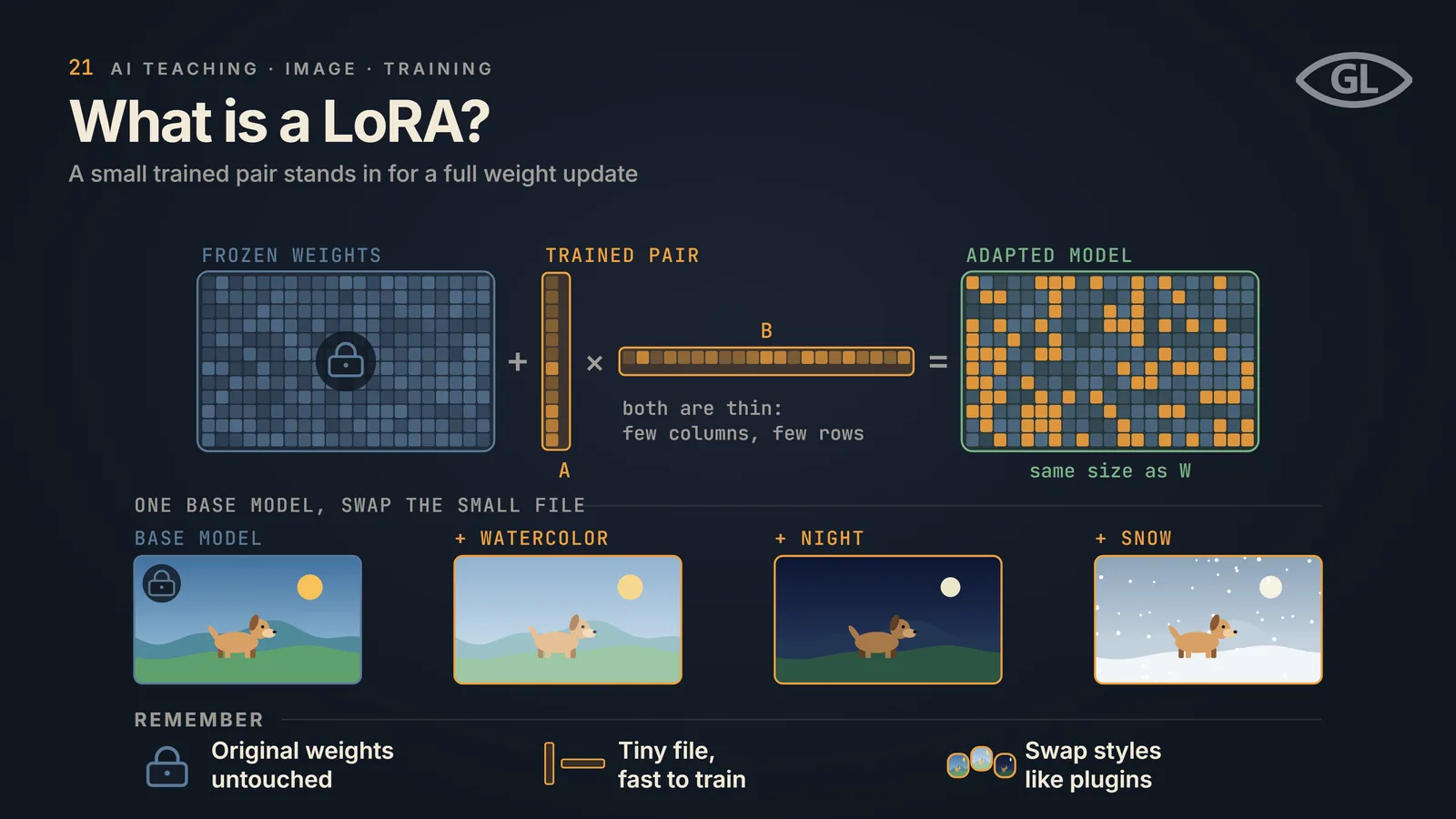
What Is a LoRA (Low-Rank Adaptation)?
LoRA (Low-Rank Adaptation) is a fine-tuning technique that freezes a pretrained model's original weights and trains a small set of new weights alongside them. It gets most of what full fine-tuning gets you for a fraction of the compute and storage.
- TRAINING TECHNIQUE
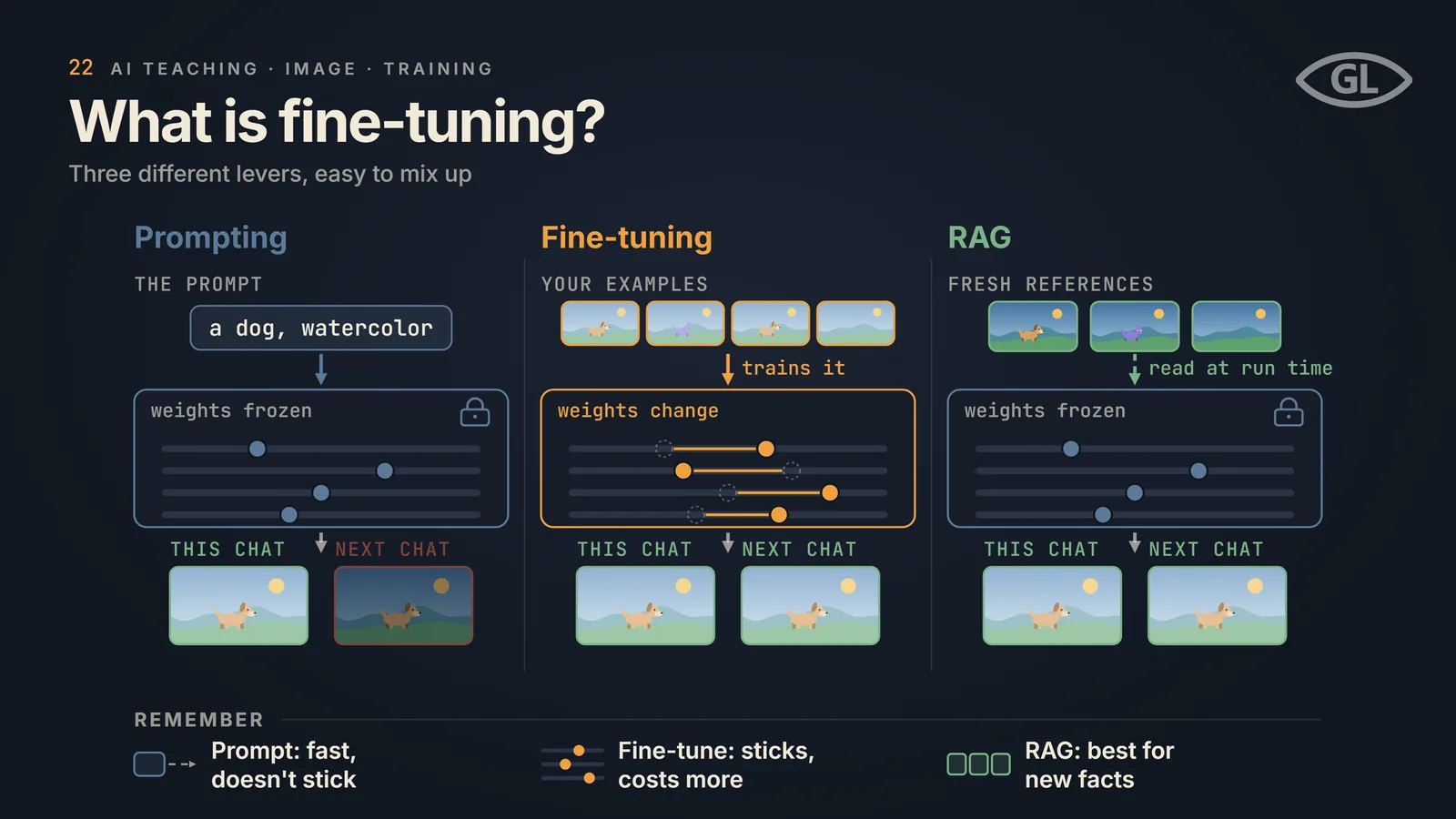
What Is Fine-Tuning a Model?
Fine-tuning takes a pretrained model and keeps training it on a smaller, more specific dataset, updating its weights so its behavior leans toward that new data. It is how a general base model becomes specialized for a task, a tone, or a domain.
- MODEL TYPE
How Does AI Image Generation Work?
Tools like Midjourney, Stable Diffusion, and DALL-E all generate images the same way: a diffusion model starts from random noise and removes a little of it at a time, steered at every step by your prompt, until a coherent image is left. This walks through that path end to end, from typed prompt to finished picture.
- MODEL TYPE
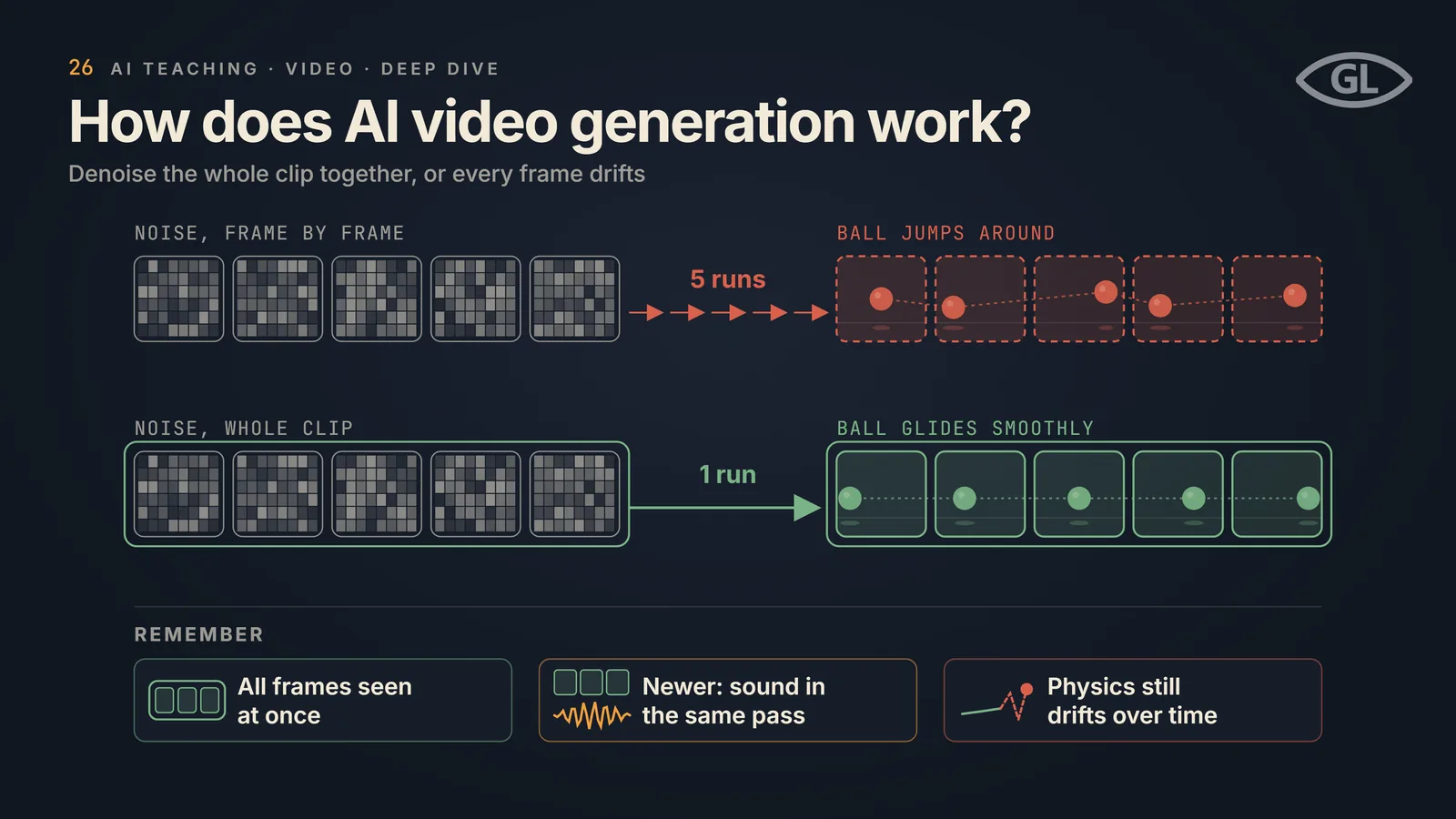
How Does AI Video Generation Work?
AI video generation takes the same denoising process behind image models and extends it across time: instead of denoising one frame, the model denoises a whole clip at once so motion stays consistent frame to frame. Newer systems like Google's Veo 3 go further and generate audio, dialogue, sound effects, ambient noise, in the same pass as the video, instead of adding it afterward.
- MODEL TYPE
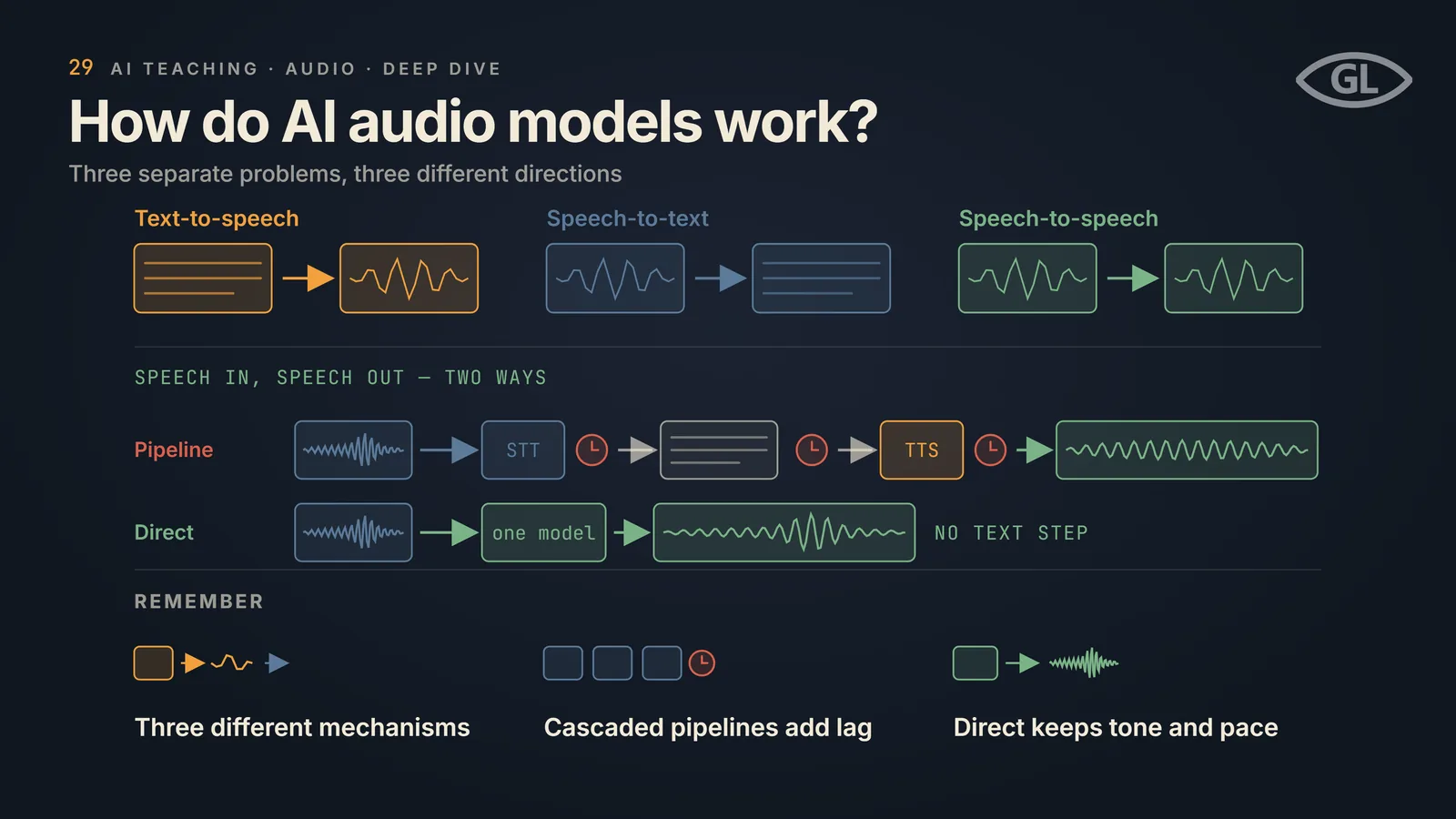
How Do AI Audio Models Work? TTS, STT, and Speech-to-Speech
AI audio covers three separate problems that get lumped together: text-to-speech (generating audio from text), speech-to-text (transcribing audio into text), and speech-to-speech (responding to spoken audio with spoken audio, without ever converting to text in between). Each uses a different mechanism, and the third is the newest and least well understood publicly.
- MODEL TYPE
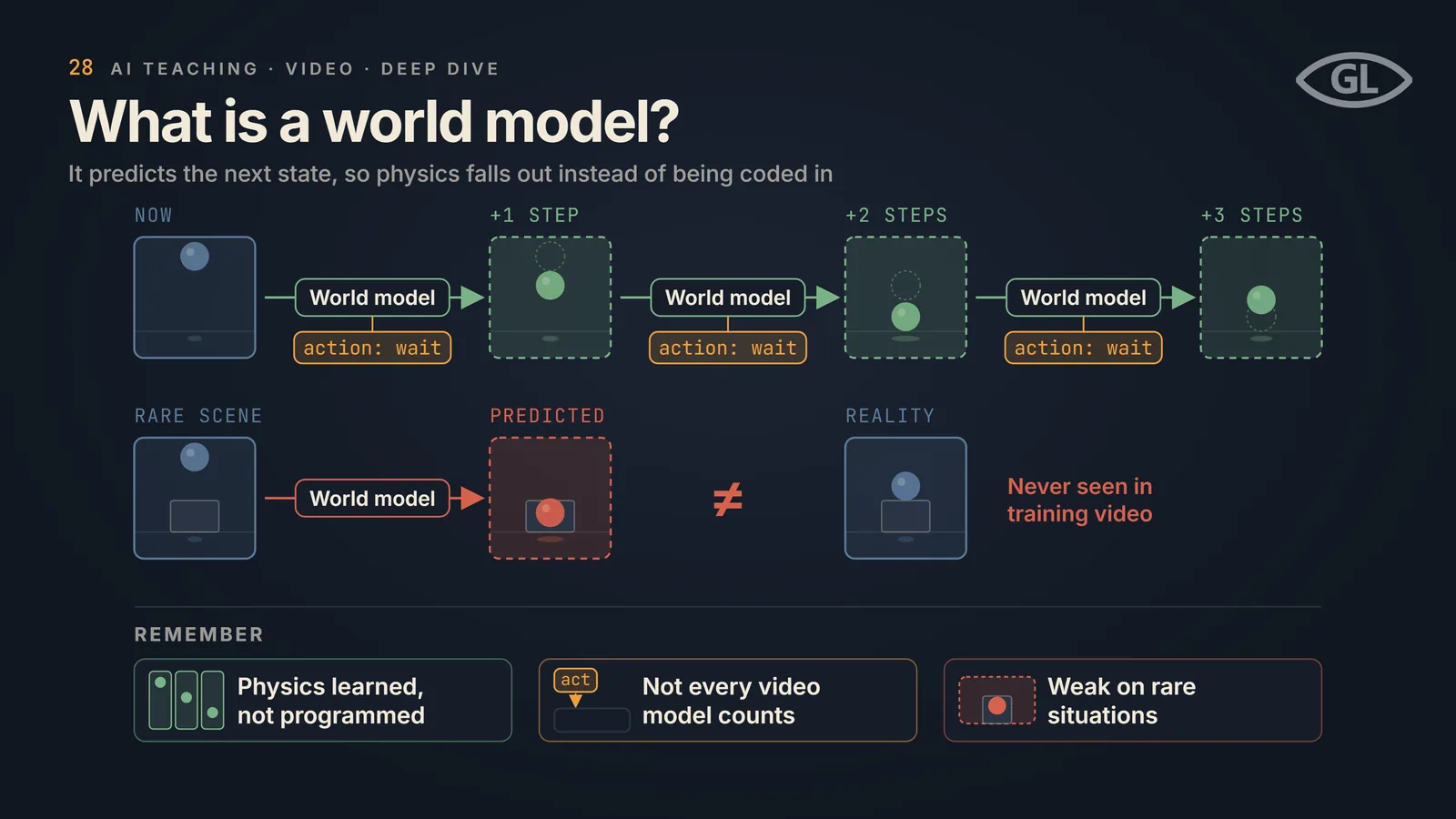
What Is a World Model?
A world model is a system trained to predict how an environment changes over time, given its current state and, often, an action taken in it. Video-generation models trained at large scale, Sora among them, are increasingly described as an early form of this: predicting the next frame well enough requires learning something like physics, object permanence, and cause and effect, even though nobody labeled any of that during training.
- MODEL TYPEVideo
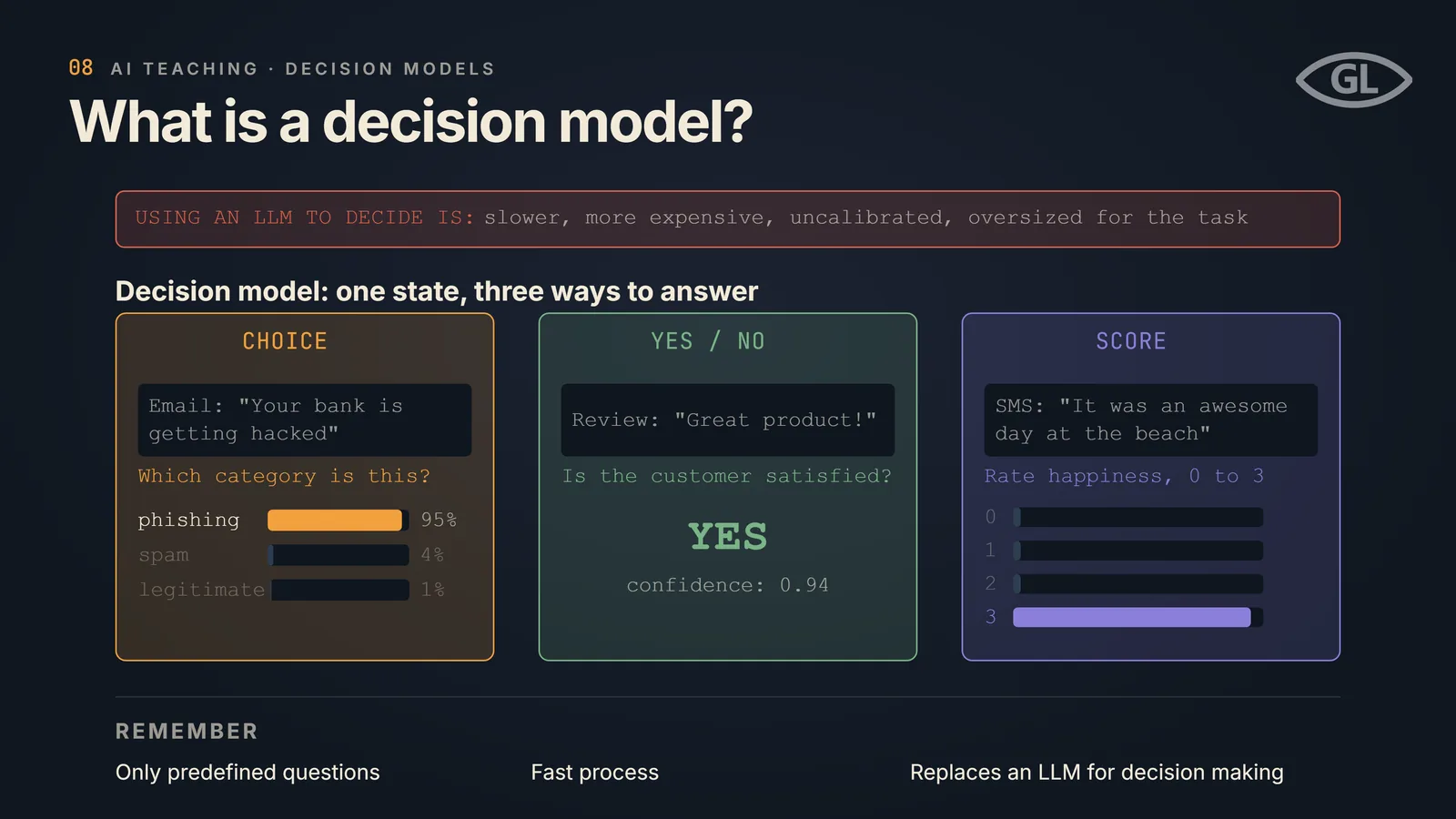
What Is a Decision Model?
A decision model takes a state (a piece of text, an event, a situation) and a predefined question, choice, score, or yes/no, and returns a calibrated probability in a single forward pass. It does not generate text. That trade buys speed and predictable output at the cost of being limited to questions you defined in advance, unlike an LLM, which can answer anything you phrase in a prompt.
- MODEL TYPE
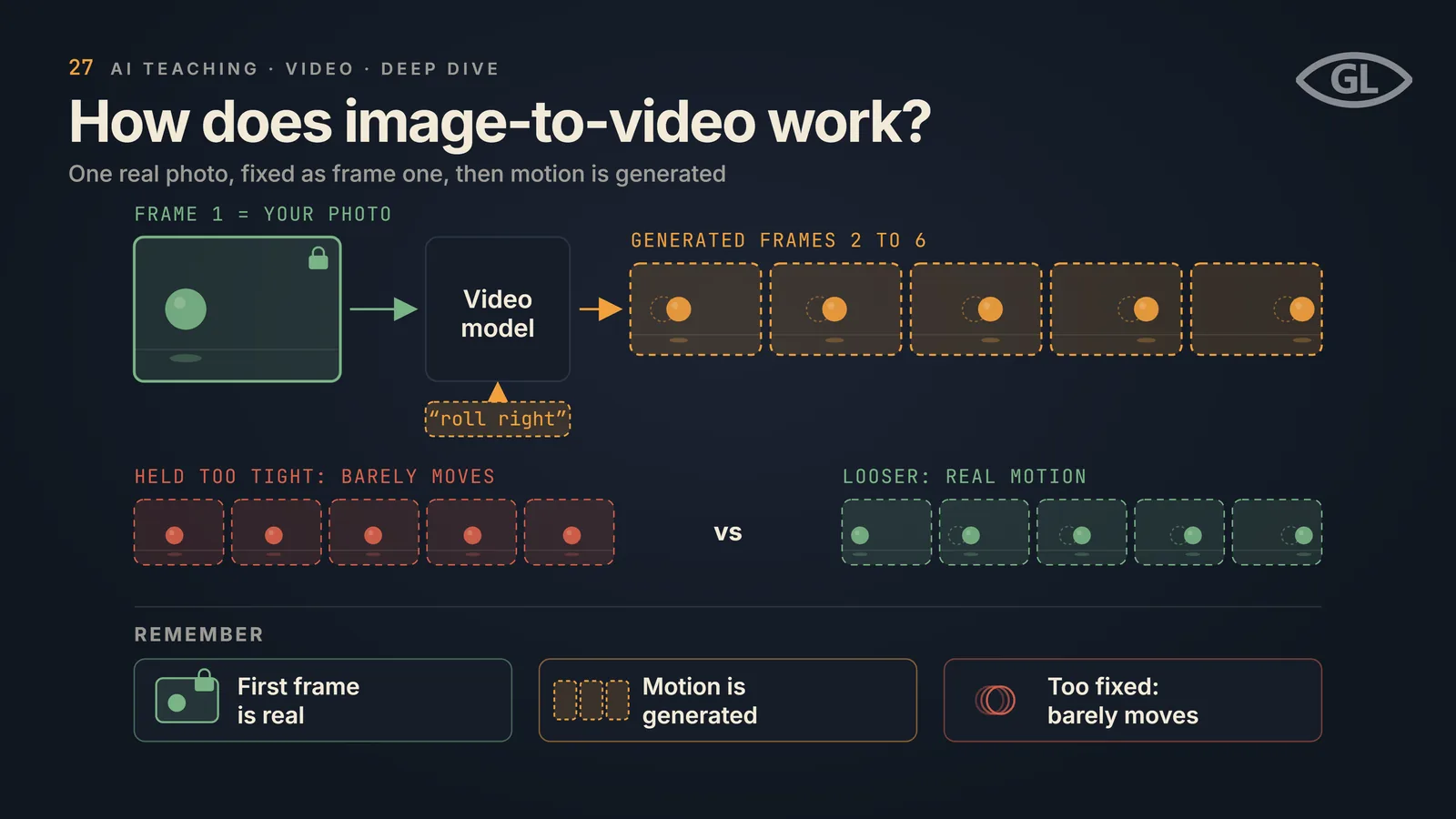
How Does Image-to-Video AI Work?
Image-to-video takes a single still photo and generates a moving clip that starts from it, instead of generating video purely from a text prompt. The photo replaces (or joins) the text prompt as the thing the model conditions on, anchoring exactly what the first frame looks like while the model generates plausible motion from there.
- MODEL TYPE
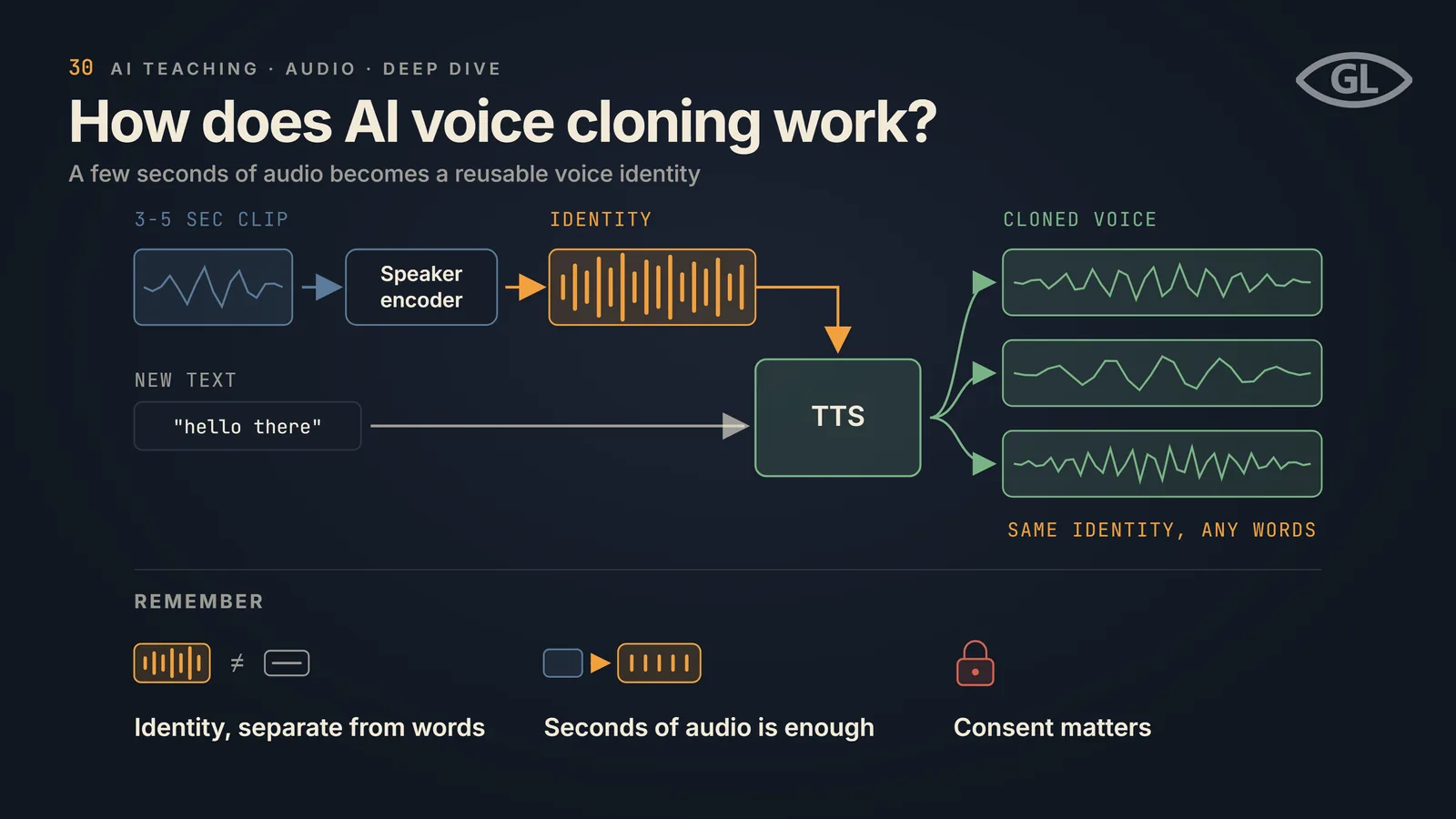
How Does AI Voice Cloning Work?
Voice cloning generates new speech in a specific person's voice, learned from a reference recording rather than performed by them. Modern systems can do this from a few seconds of audio, by separating what a speaker sounds like from what they're saying and recombining that identity with new content.
- MODEL TYPE
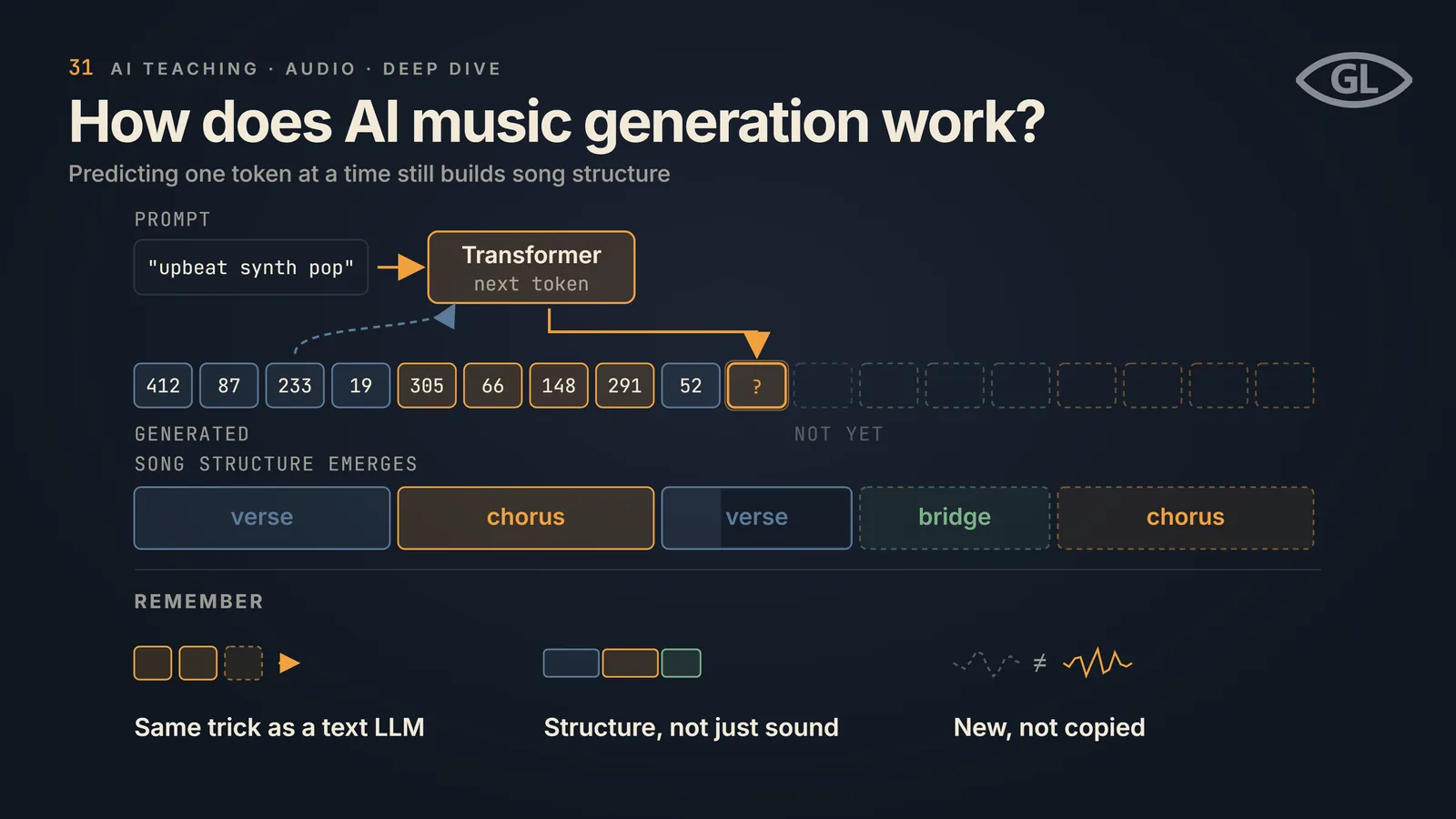
How Does AI Music Generation Work?
AI music generation turns a text description, and often lyrics, into a finished audio track: melody, instrumentation, vocals, structure, all at once. The dominant approach treats compressed audio as a sequence of discrete tokens and trains a transformer to predict them, the same next-token mechanism behind a text LLM, applied to sound instead of words.
- MODEL TYPE
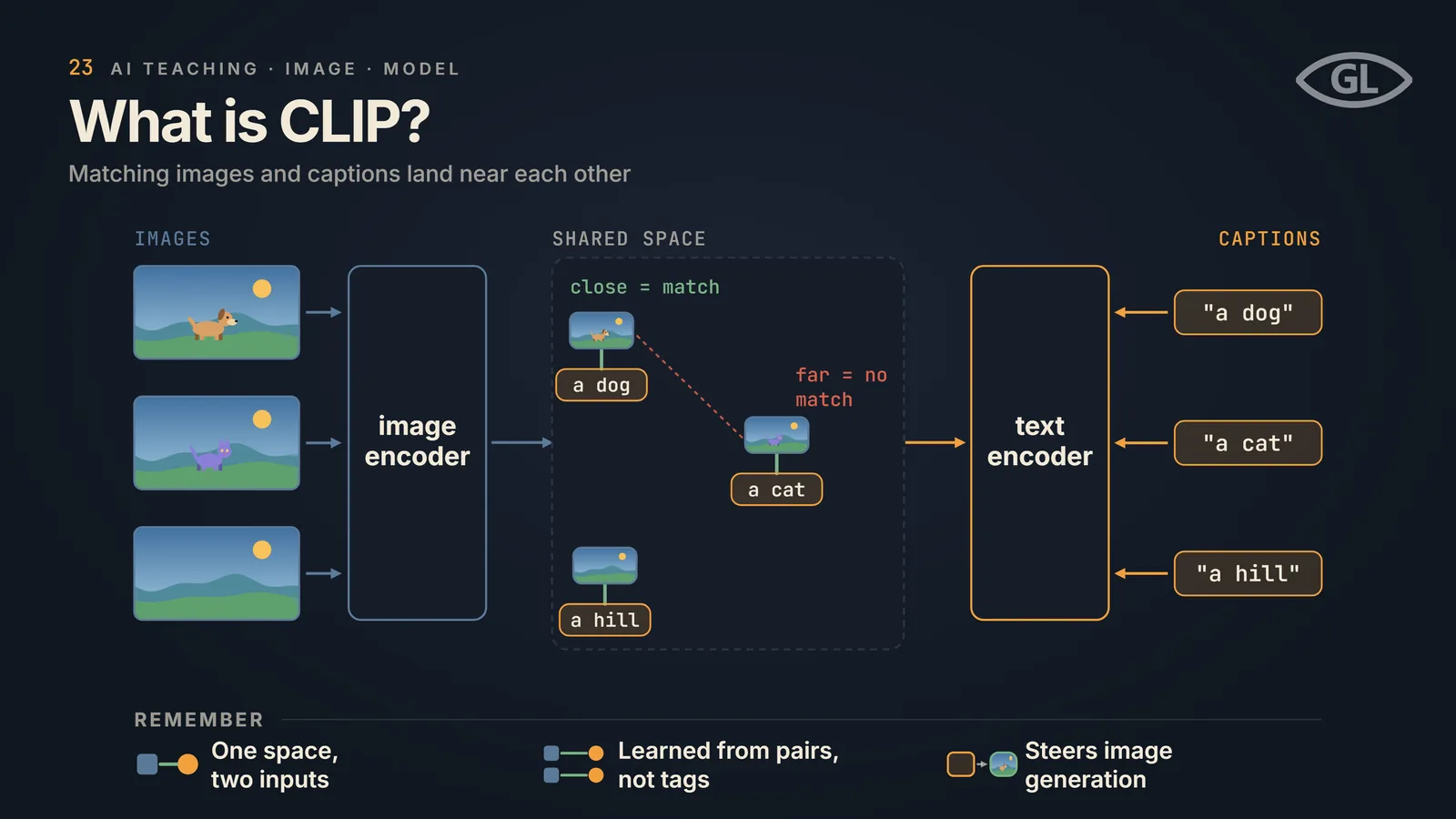
What Is CLIP?
CLIP (Contrastive Language-Image Pre-training) is a pair of neural networks, one for images and one for text, trained so that a matching image and caption land near each other in the same numeric space. That shared space is what lets a text-to-image model check how well a picture matches a prompt, and it's the mechanism most current image generators condition on.
- MODEL TECHNIQUE
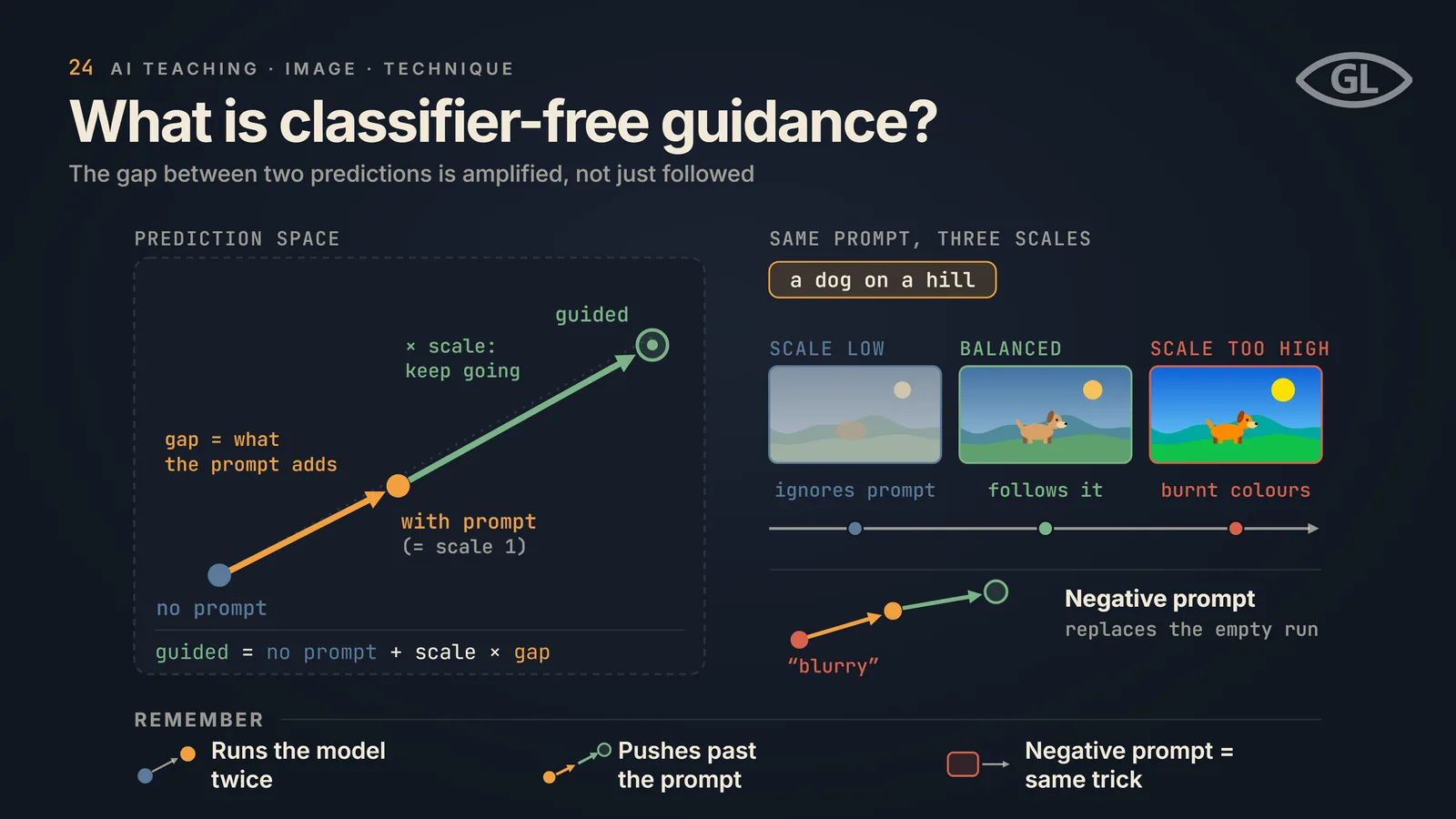
What Is Classifier-Free Guidance (CFG)?
Classifier-free guidance (CFG) is the technique that makes a diffusion model's output actually match its prompt, instead of producing a generically plausible image or video that only loosely reflects it. It works by generating two predictions at every denoising step, one with the prompt and one without, and pushing the result further in the direction the prompt adds. The same mechanism, run against an unwanted description instead of an empty one, is what a negative prompt does.
- MODEL TASK
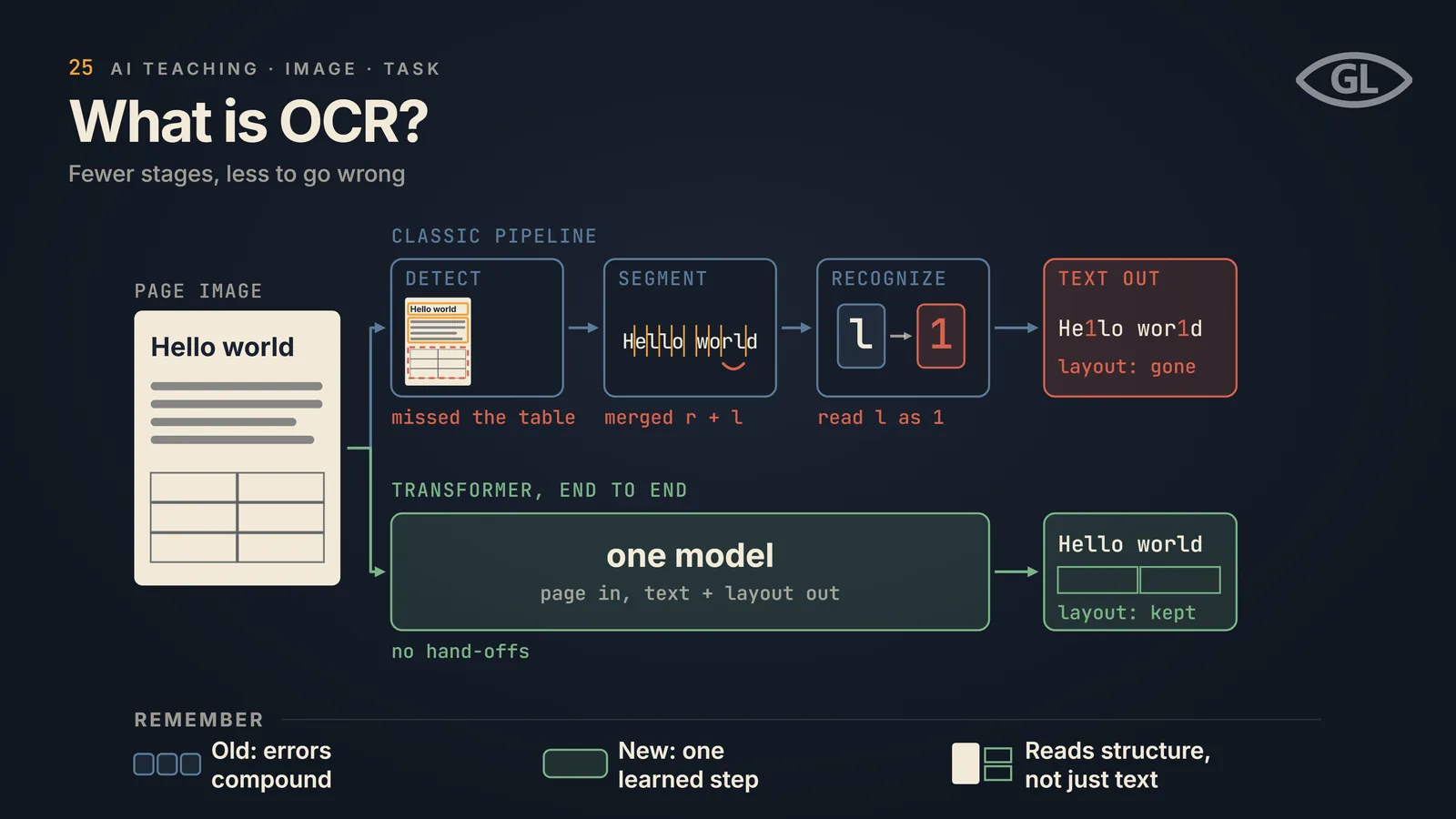
What Is OCR (Optical Character Recognition)?
OCR (optical character recognition) is the task of turning an image containing text, a scanned page, a photo of a sign, a screenshot, into machine-readable text. What counts as state of the art has changed twice: from matching pixel shapes against known letterforms, to a pipeline of separate detection and recognition models, to today's transformer models that read a whole document image and output structured text directly, no separate character-matching step at all.
- MODEL TYPE
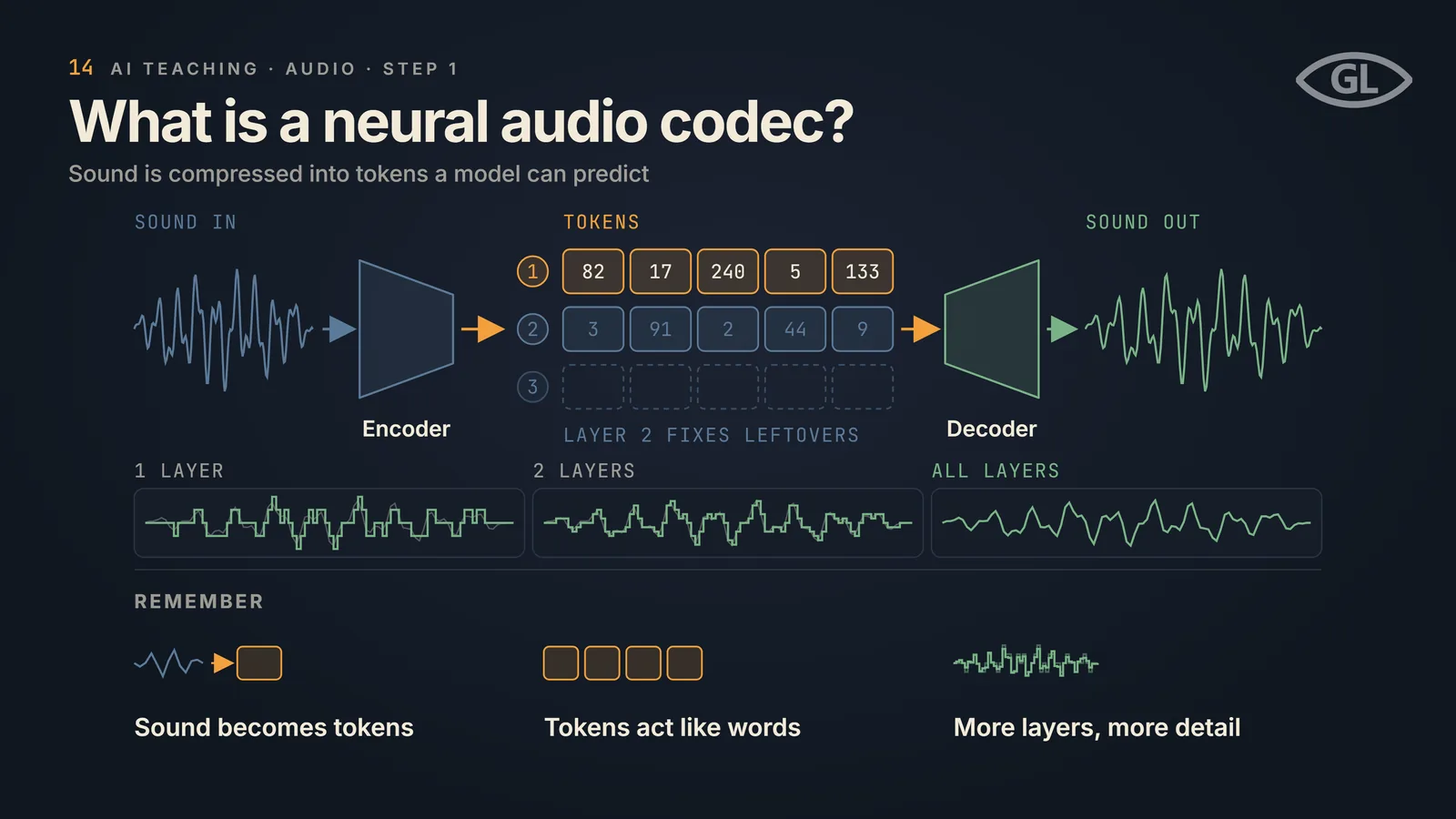
What Is a Neural Audio Codec?
A neural audio codec turns a sound wave into a short sequence of discrete tokens, and back again, using a neural network instead of a fixed math formula. Those tokens are what let a transformer generate or understand audio the same way it generates or understands text: by predicting the next one.
- MODEL TYPE
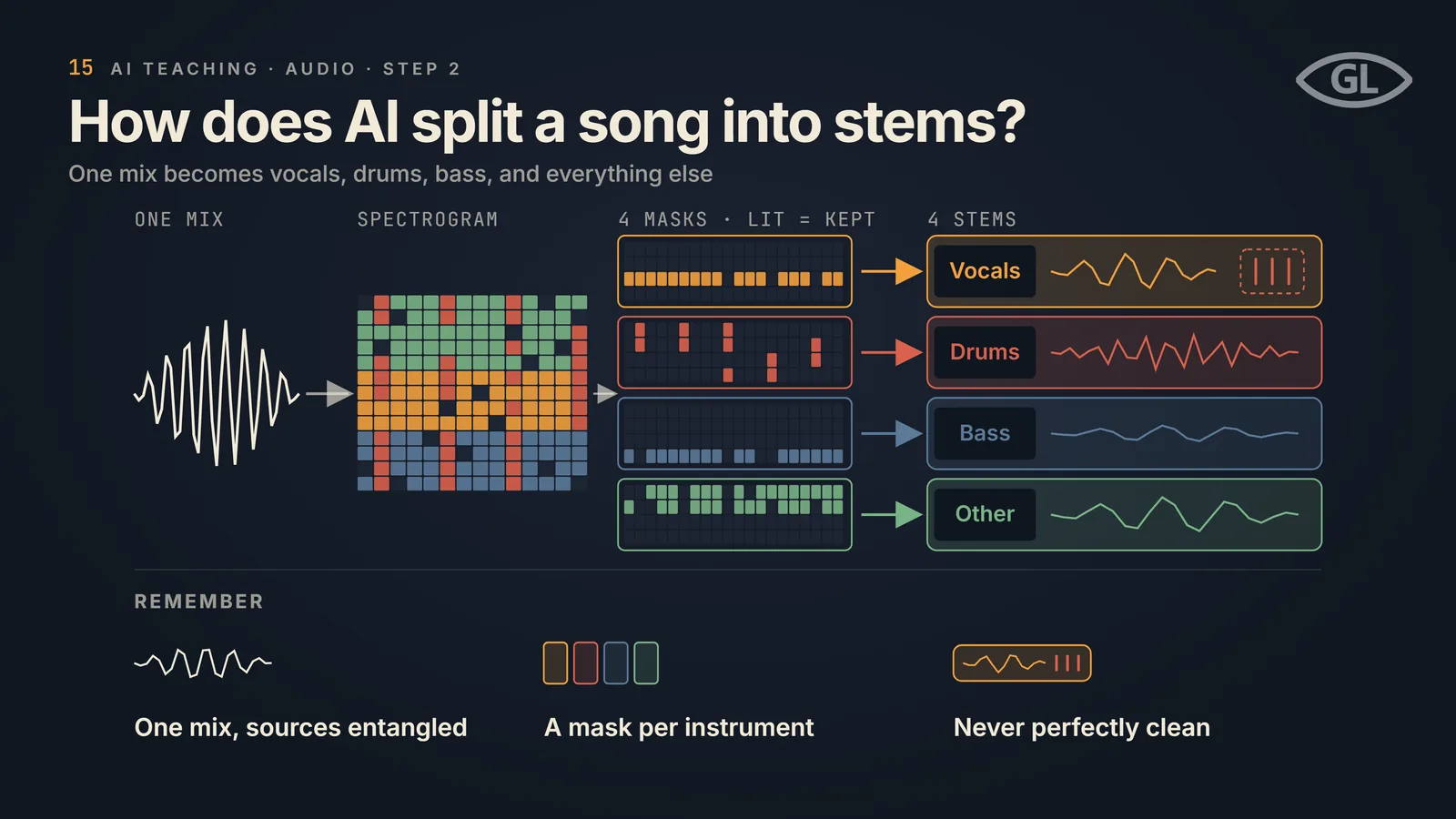
How Does AI Audio Source Separation Work?
Audio source separation splits one mixed recording, like a finished song, back into its individual parts: vocals, drums, bass, everything else. It works by training a model to recognize what each instrument's sound looks like in a spectrogram, then predicting a mask that pulls each one out of the mix.
- MODEL TYPE
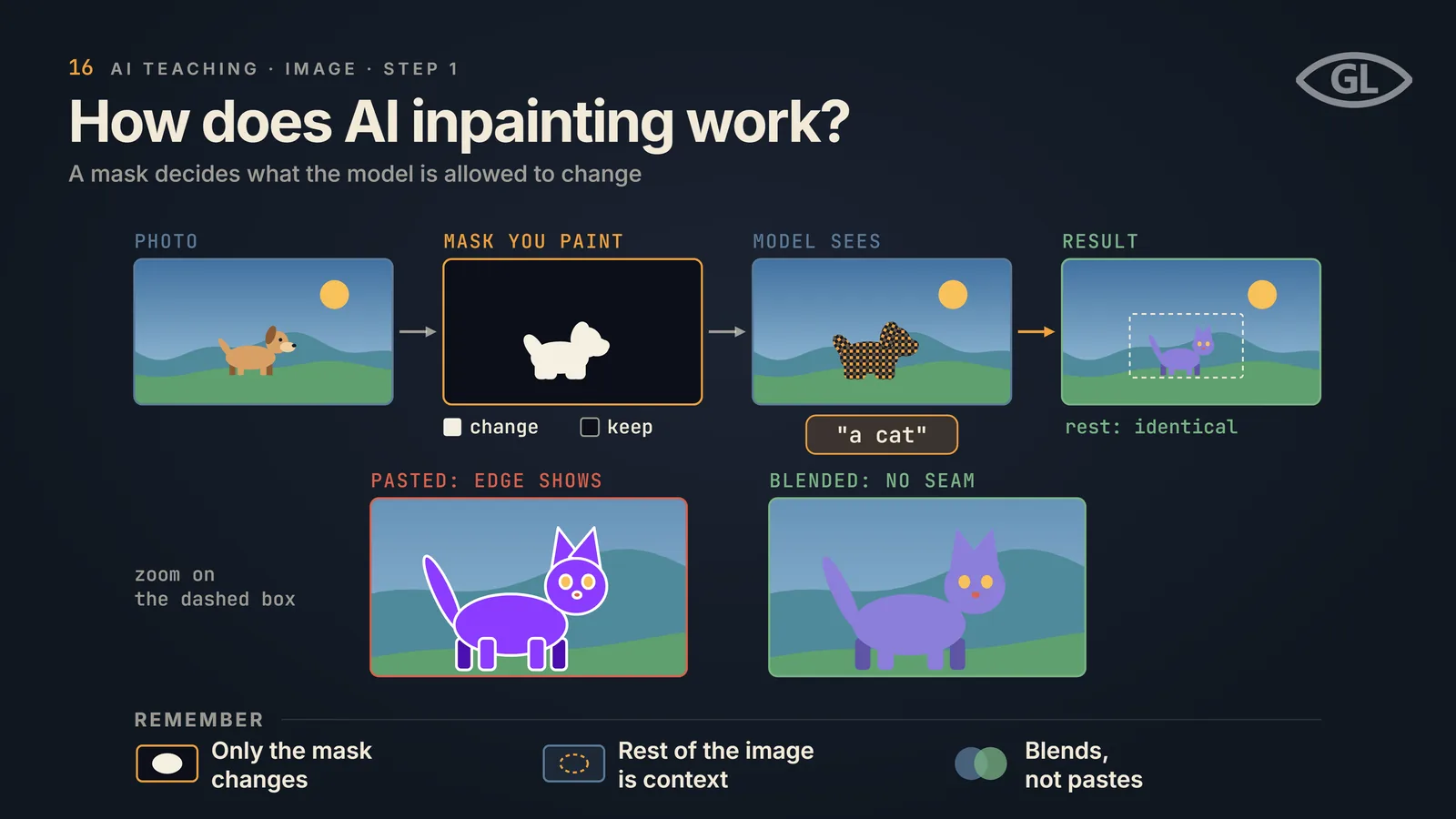
How Does AI Image Inpainting Work?
Inpainting lets a diffusion model change one region of an image, removing an object, filling a gap, swapping what's in a selection, while leaving the rest of the picture exactly as it was. It works by using a mask to tell the model which pixels it's allowed to touch, then running the same denoising process as text-to-image generation only inside that boundary.
- MODEL TYPE
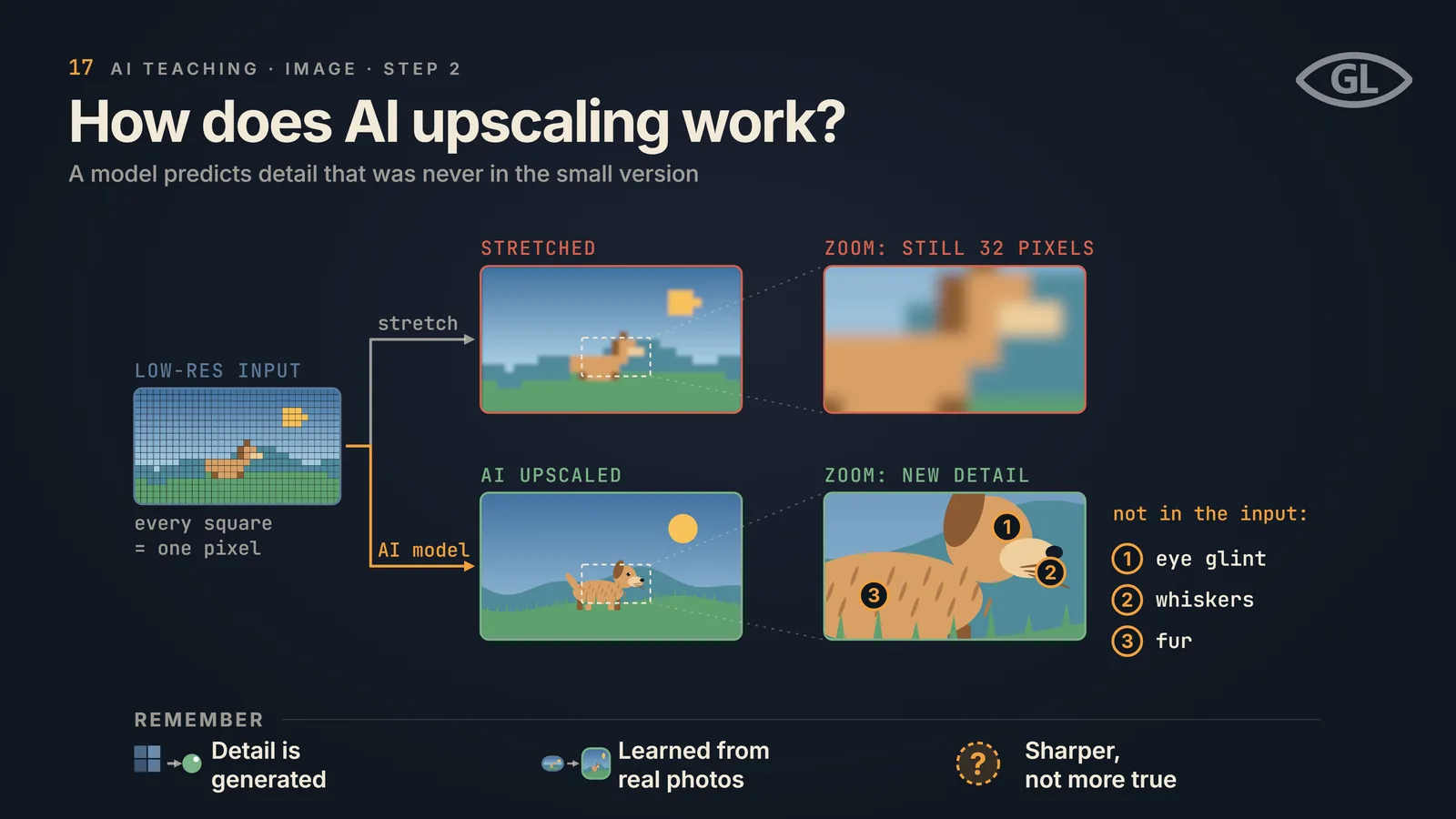
How Does AI Image Upscaling Work?
AI upscaling increases an image's resolution by generating new, plausible detail rather than stretching existing pixels to fill more space. A model trained on pairs of high- and low-resolution images learns what fine texture, sharp edges, and grain tend to look like, then predicts convincing detail for a blurry input it has never seen.
- MODEL TYPE
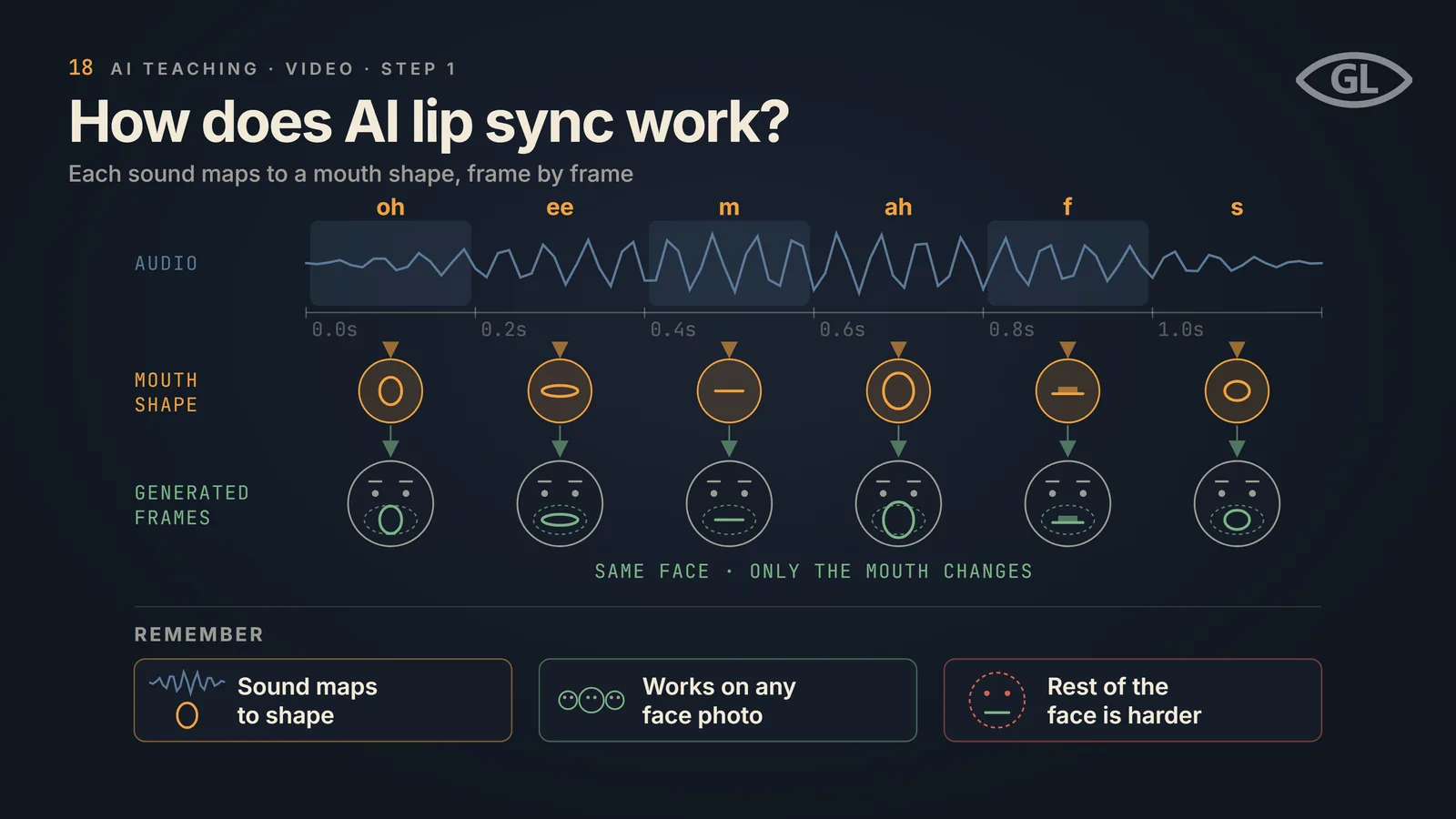
How Does AI Lip Sync Work?
AI lip sync takes a face, a photo, a video, or a still image, and an audio track, and generates video of that face speaking in sync with the audio. It works by reading the sounds in the audio track and predicting, frame by frame, the mouth shape a real speaker would make to produce that sound, then rendering that shape onto the face.
- MODEL TYPE
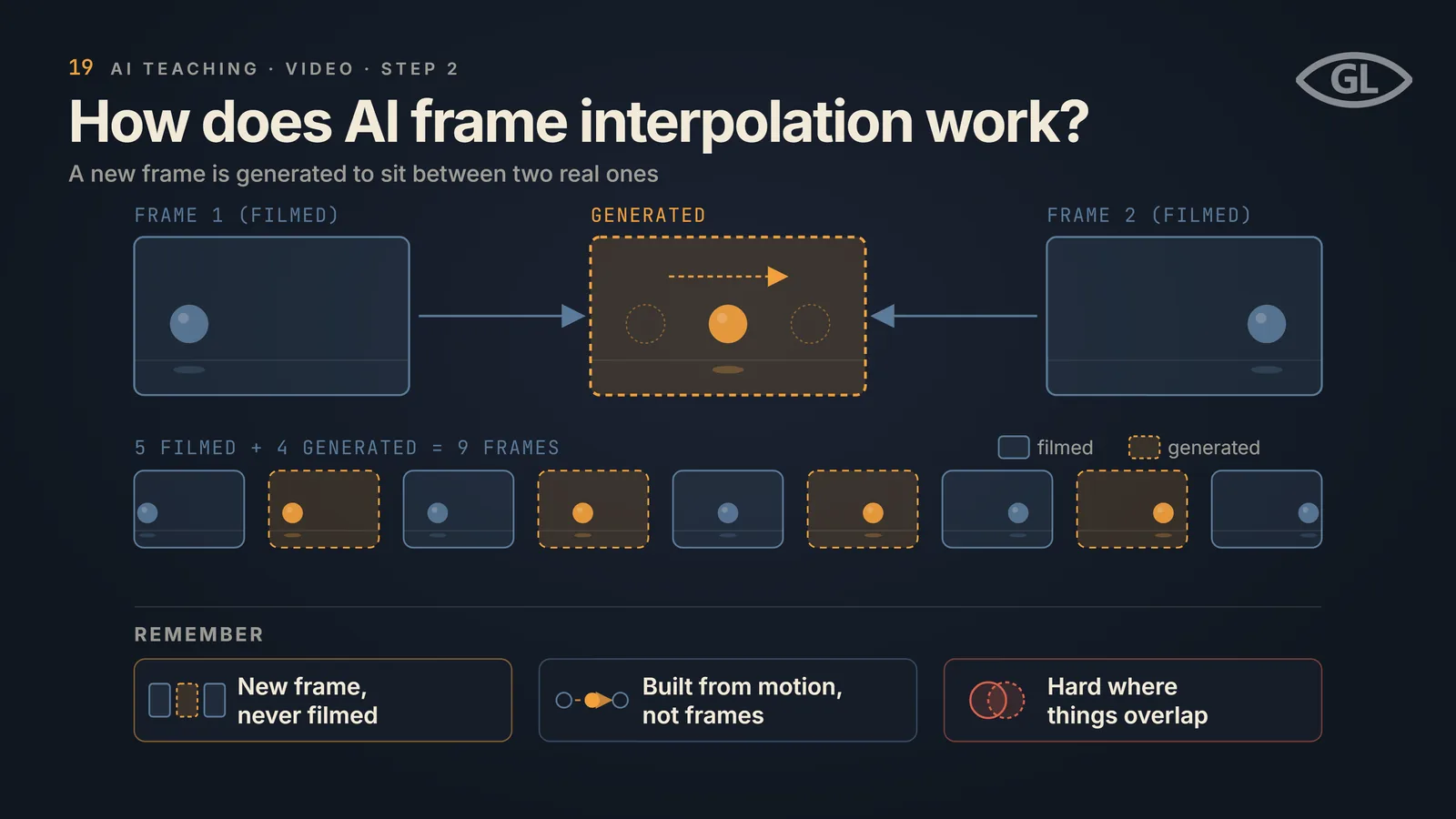
How Does AI Frame Interpolation Work?
Frame interpolation generates new frames that sit between two existing video frames, turning, for example, a 24-frames-per-second clip into 48 or 60 without re-shooting anything. It works by estimating how everything in the scene is moving between the two frames, then synthesizing a new frame that shows where that motion would be exactly halfway through.
- LLM · STEP 1
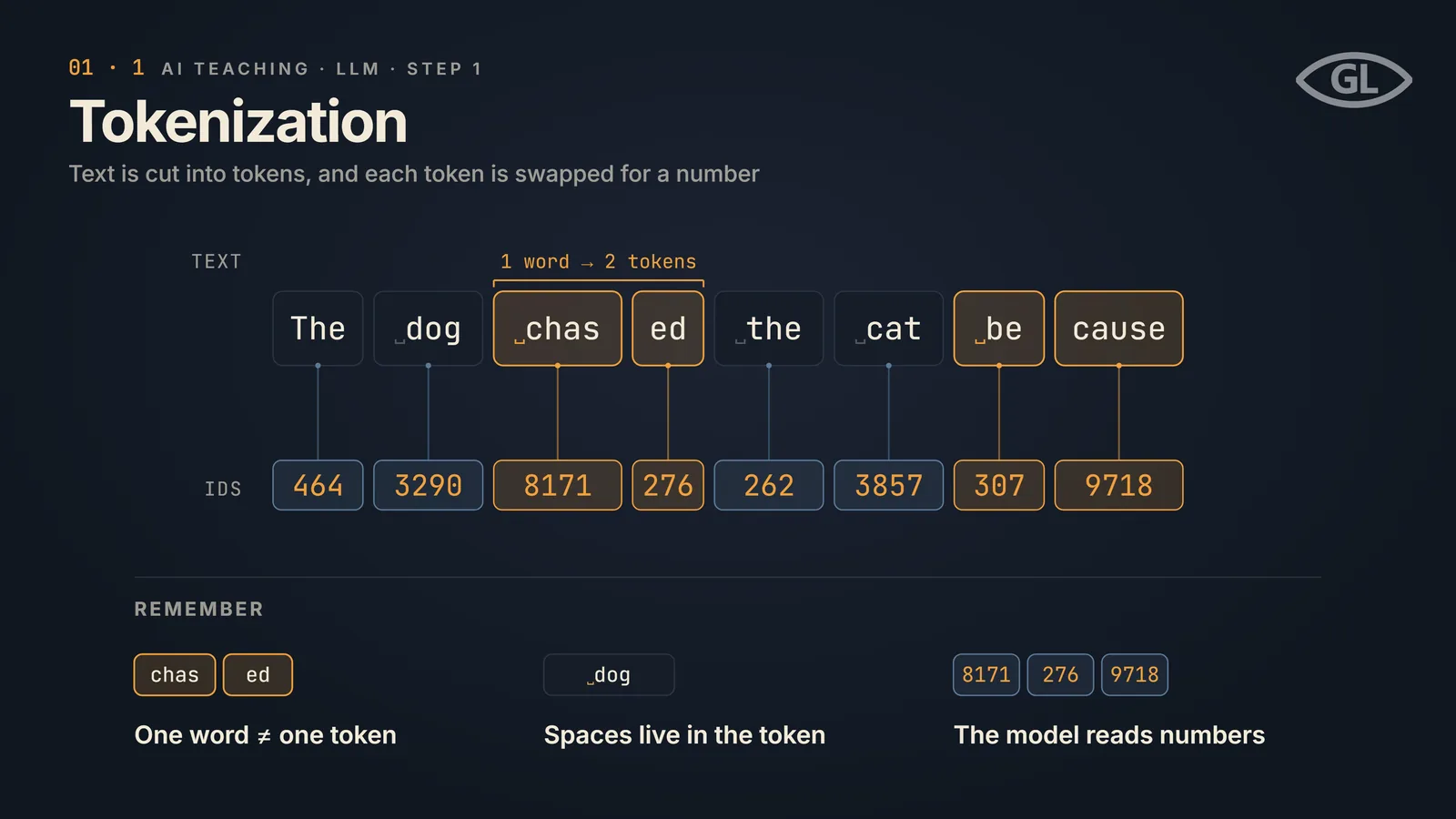
What Is Tokenization?
Tokenization is the first thing that happens to any text an LLM processes: the text is sliced into tokens, chunks that are often smaller than a whole word, and each token is swapped for an integer ID from a fixed vocabulary. A neural network operates on numbers, not letters, so this conversion is the entry point for everything downstream.
- LLM · STEP 2
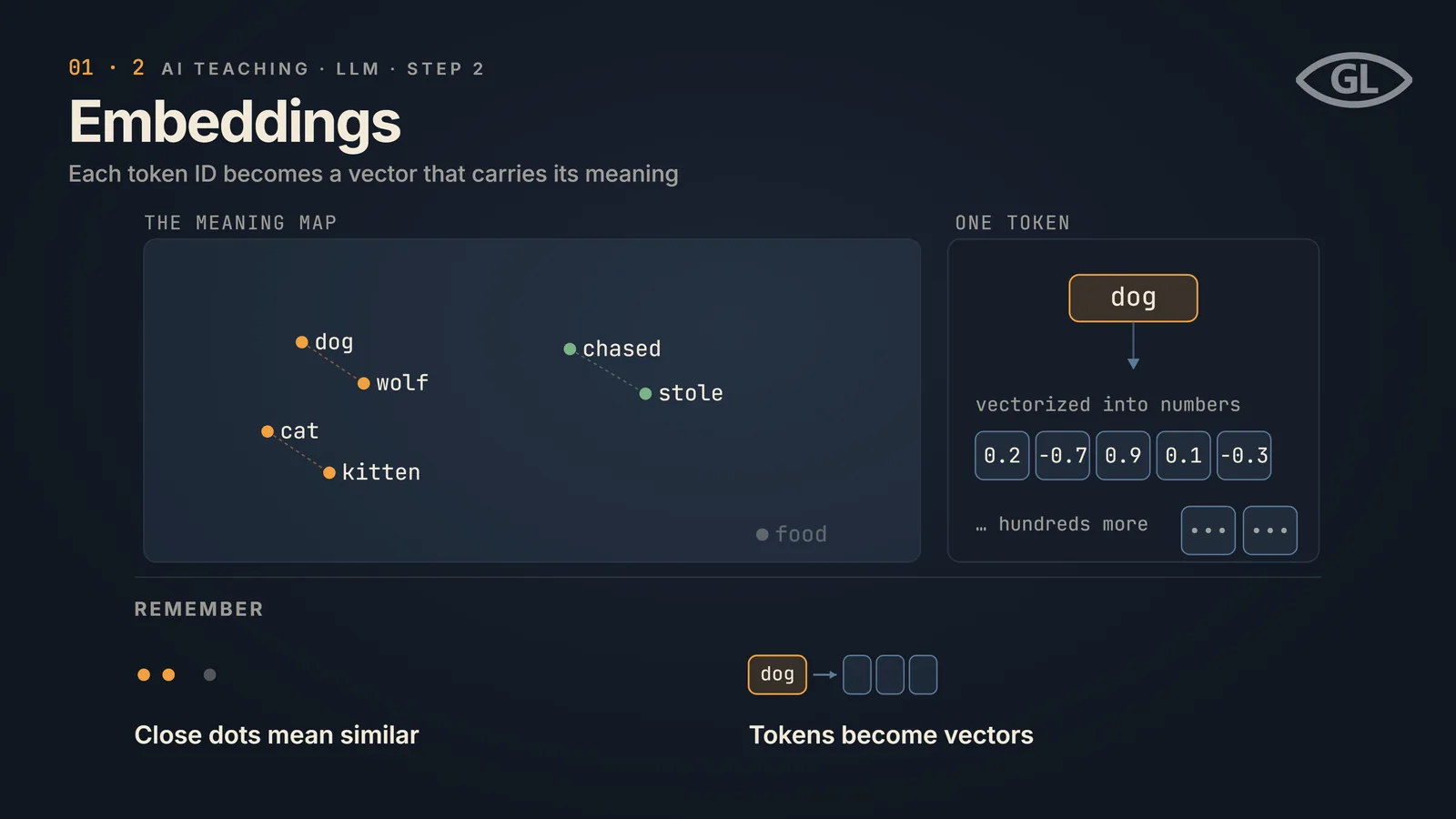
What Are Embeddings?
An embedding is a vector, a list of numbers, that stands in for a token's meaning. After tokenization turns text into integer IDs (see what tokenization is), each ID is looked up in an embedding table and swapped for its vector, positioned in a high-dimensional space where tokens with similar meaning land close together and unrelated tokens land far apart.
- LLM · STEP 3
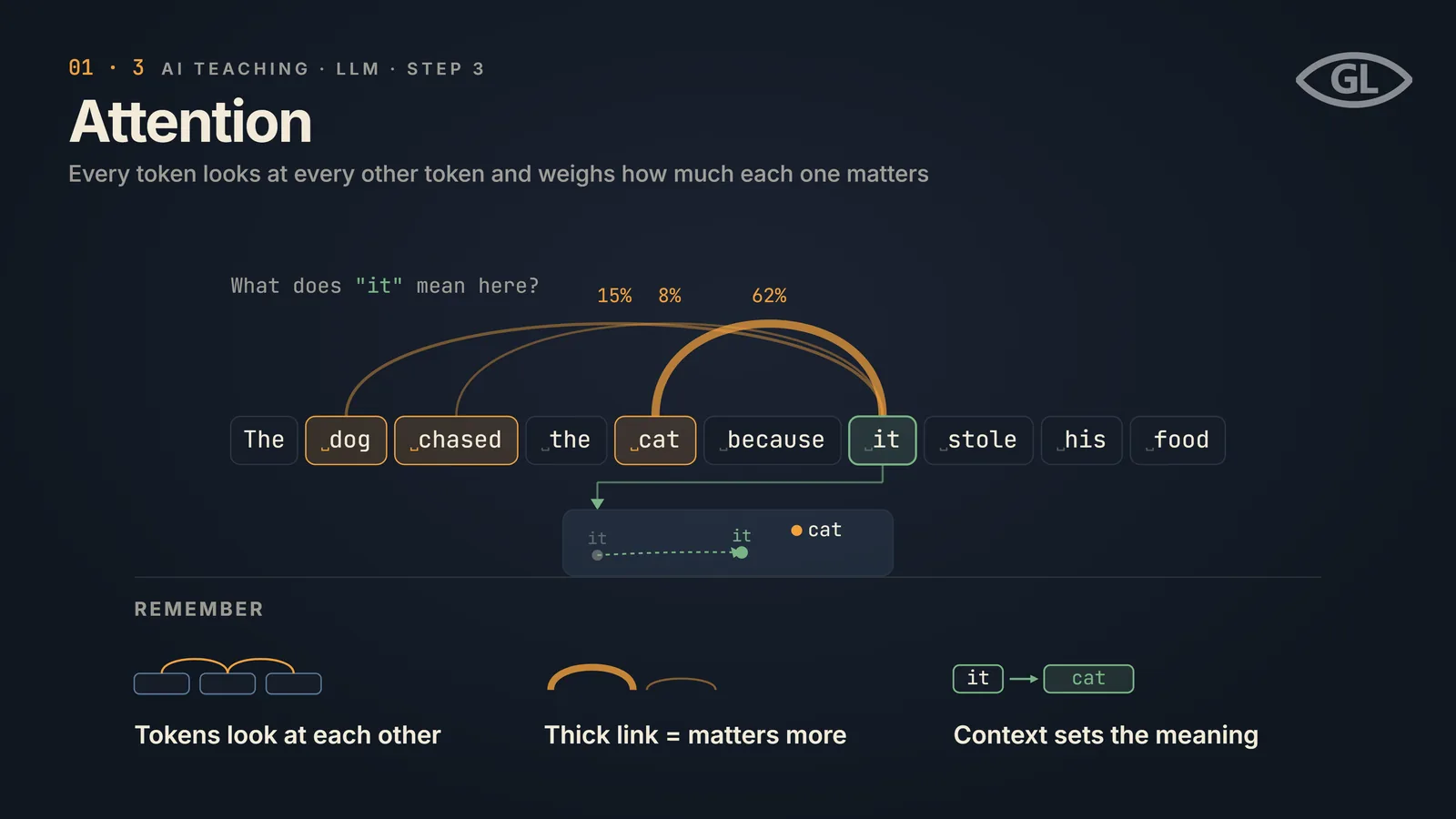
What Is Attention in a Transformer?
Attention is the core mechanism inside a transformer that lets every token look at every other token in the input and decide how much each one should matter to it. It's how a model figures out what a pronoun refers to, or which earlier word gives a later one its specific meaning, regardless of how far apart they sit in the text.
- LLM · STEP 4
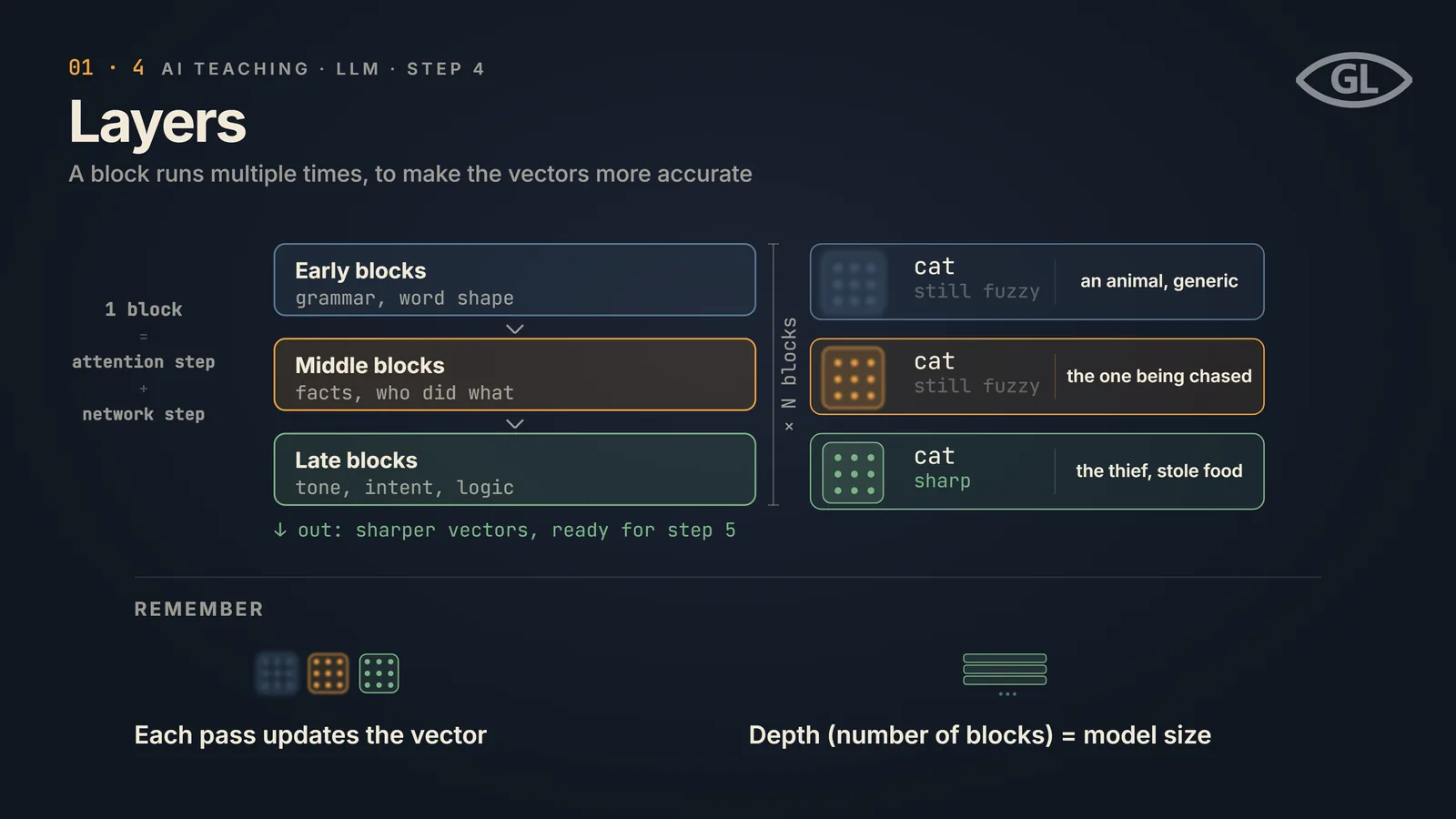
What Are Transformer Layers?
A transformer isn't one computation, it's the same block, attention followed by a small feed-forward network, repeated dozens of times in a stack, each layer feeding its output to the next. Stacking that one block is what turns a token's vector from a shallow signal about word shape into a rich representation carrying facts, relationships, and intent.
- LLM · STEP 5
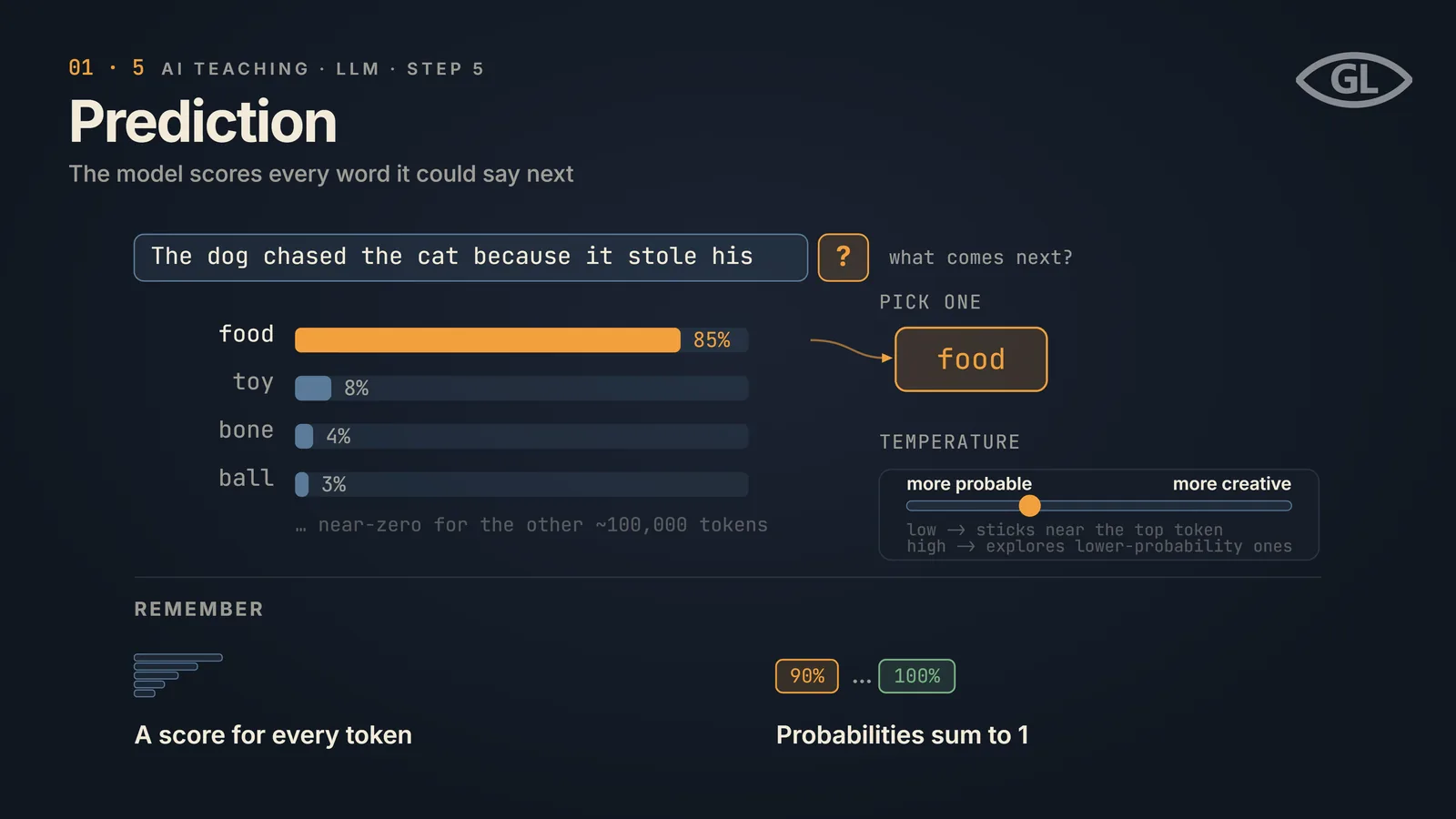
How Does Next-Token Prediction Work?
After a token's vector has passed through every layer (see what transformer layers are), the model's last step converts that final vector into one probability for every token in its entire vocabulary, tens of thousands of candidates scored at once, then samples the actual next token from that distribution rather than always taking the top score.
- LLM · STEP 6
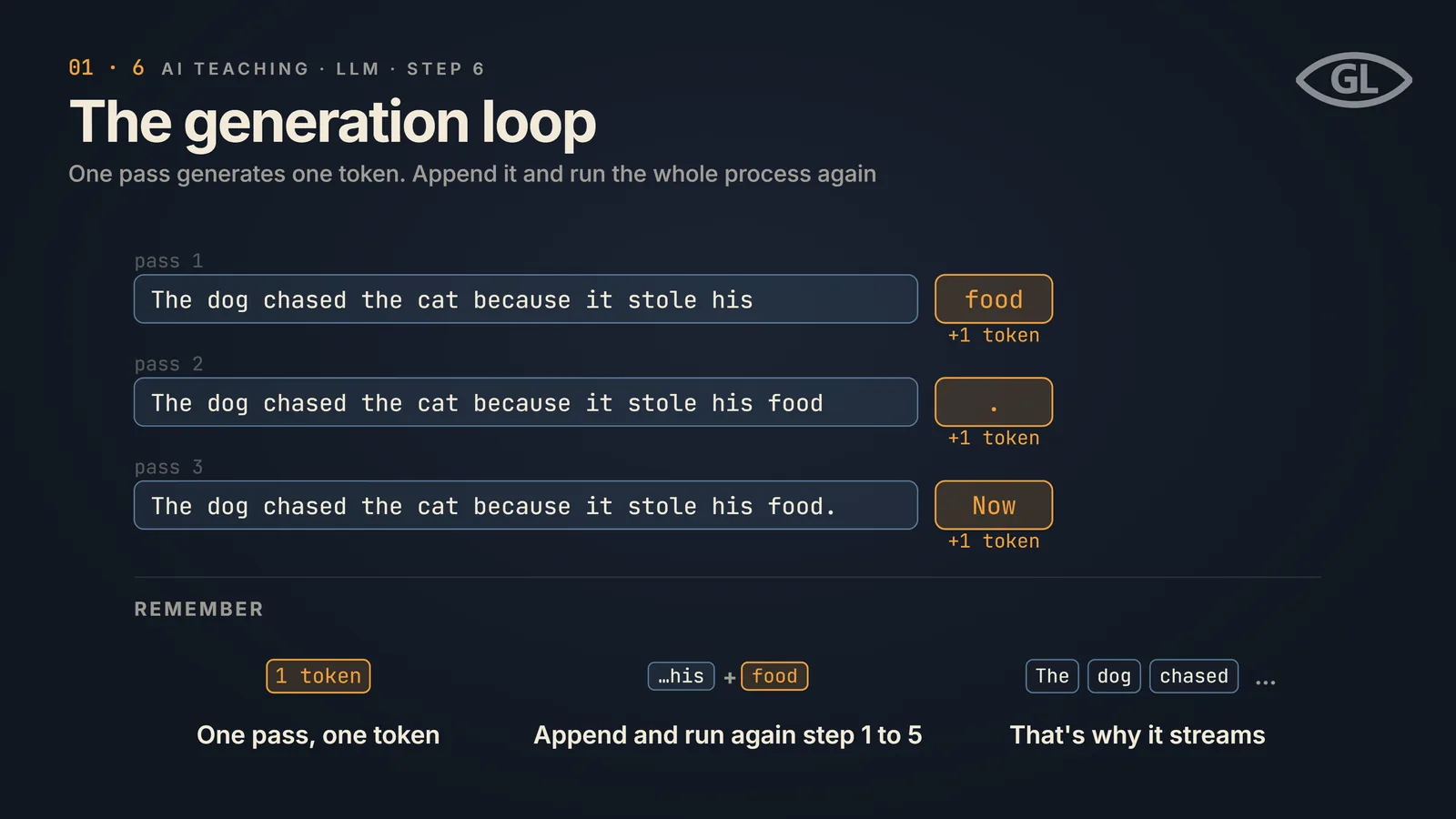
How Does the Generation Loop Work?
A full LLM answer, a paragraph, a block of code, is never produced in one shot. Every step covered so far, tokenizing, embedding, attention, layers, prediction, runs to produce exactly one new token. That token gets appended to the sequence, and the entire model runs again on the longer input to produce the next one. This loop, repeated until the answer is done, is the generation loop.
- MODEL TECHNIQUE
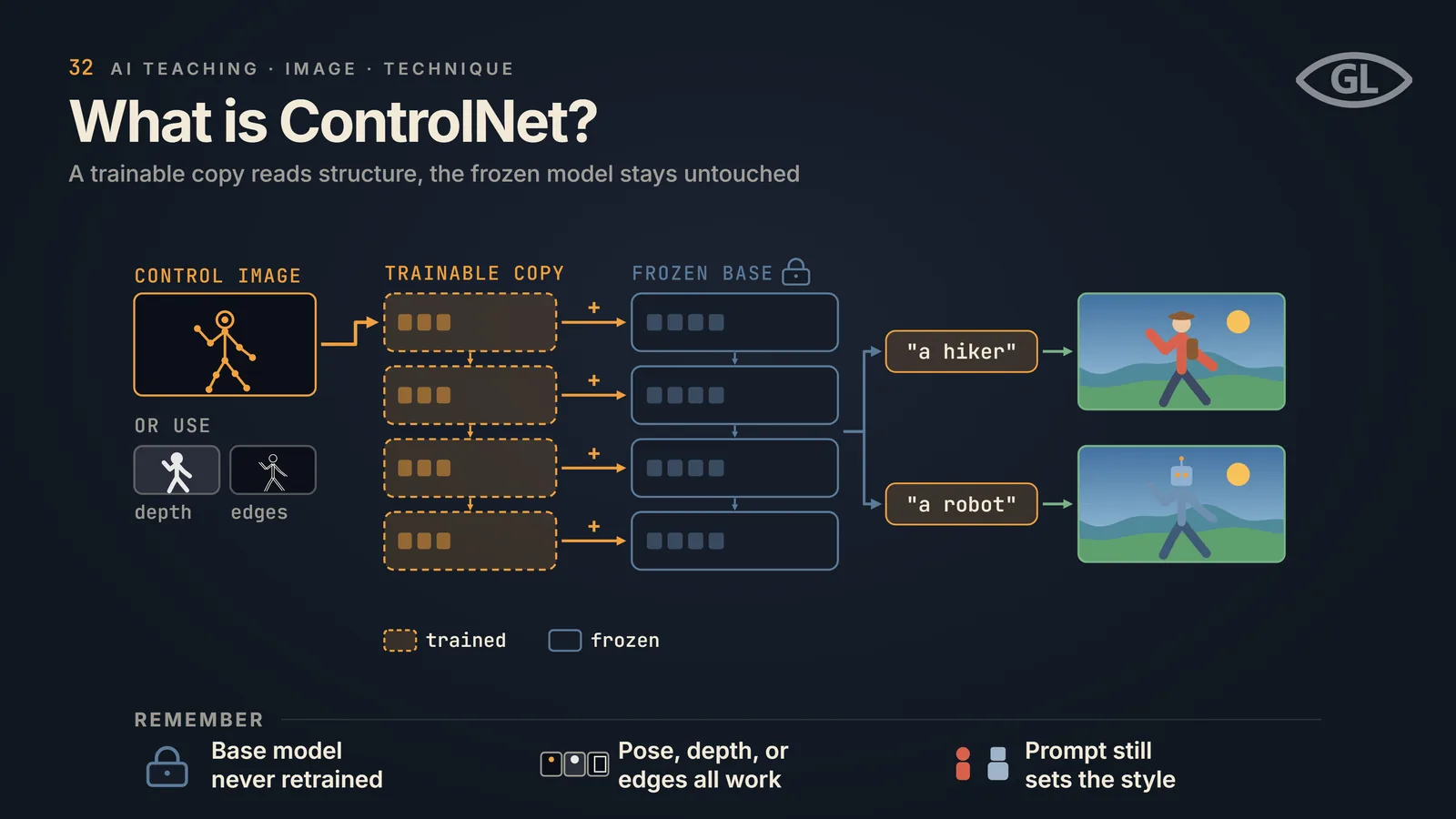
What Is ControlNet?
ControlNet adds a second, structural input to a diffusion model, a pose skeleton, a depth map, an edge sketch, alongside the usual text prompt, so generation follows that structure exactly instead of just approximating what the prompt describes. It does this without retraining or even touching the base model's original weights.
- MODEL TYPE
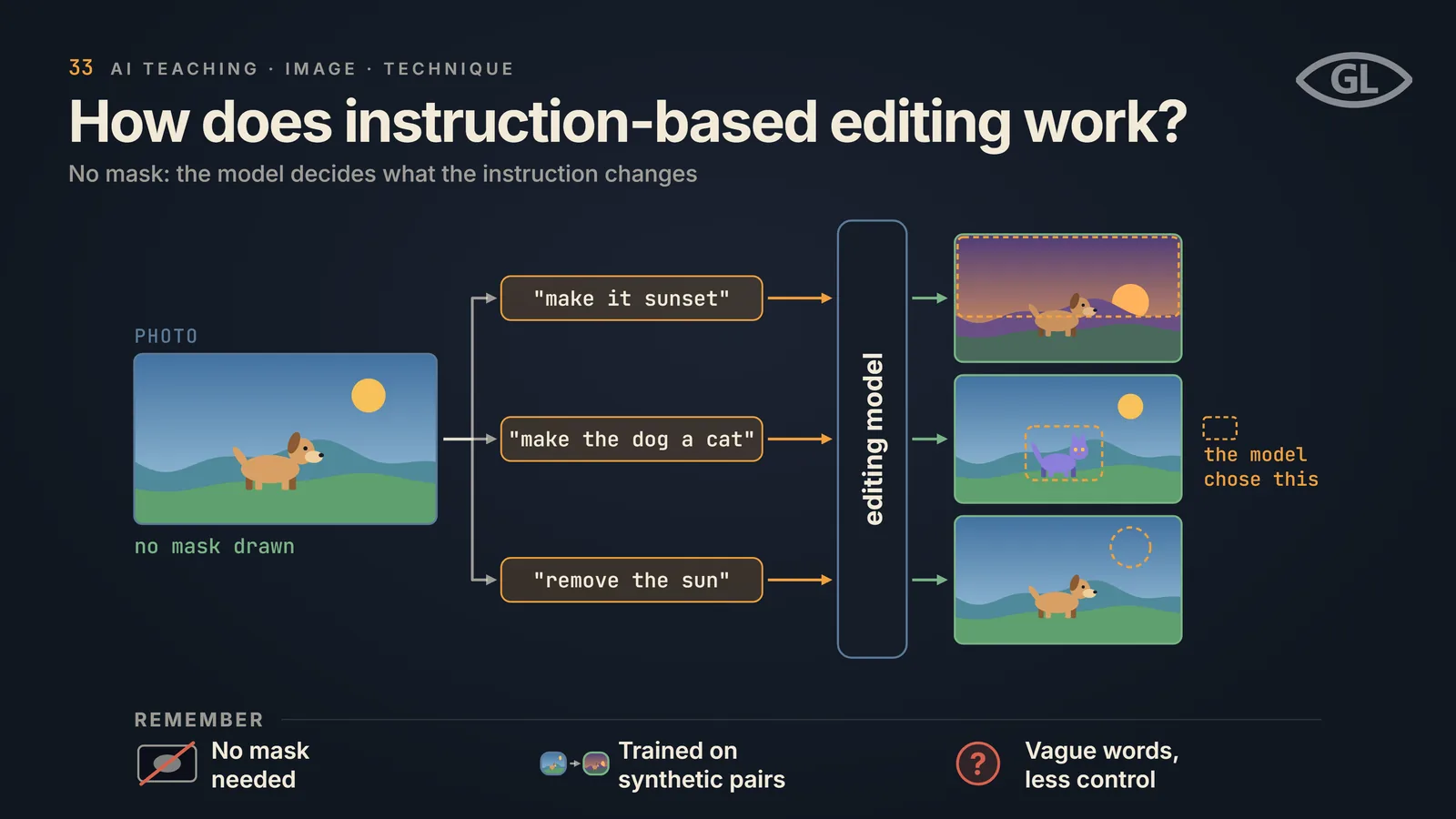
How Does AI Image Editing by Instruction Work?
Instruction-based image editing takes a plain-language command, "make it night," "add a hat," "turn the car red," and edits an existing image to match, without a mask marking which pixels to change. That's a different mechanism from inpainting (see how AI image inpainting works): no region is selected ahead of time, the model has to figure out what the instruction implies changing on its own.
- MODEL TECHNIQUE
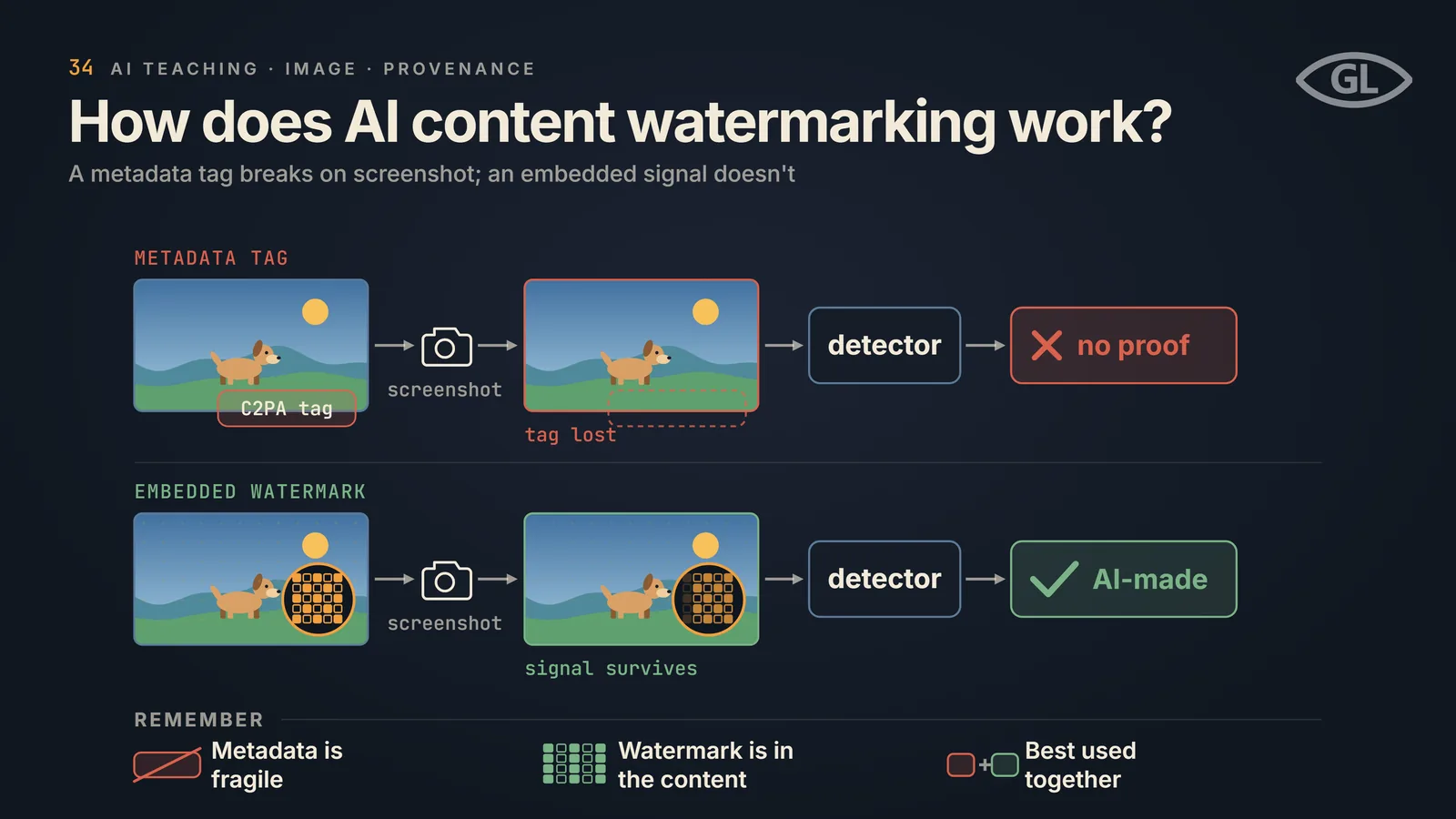
How Does AI Content Watermarking Work?
Marking AI-generated content so it can later be identified uses two structurally different approaches: a signed metadata record attached to the file (C2PA Content Credentials), and a signal embedded directly into the pixels or audio samples themselves (watermarking, like Google's SynthID). They fail differently, which is why platforms increasingly use both together.
- MODEL TYPE
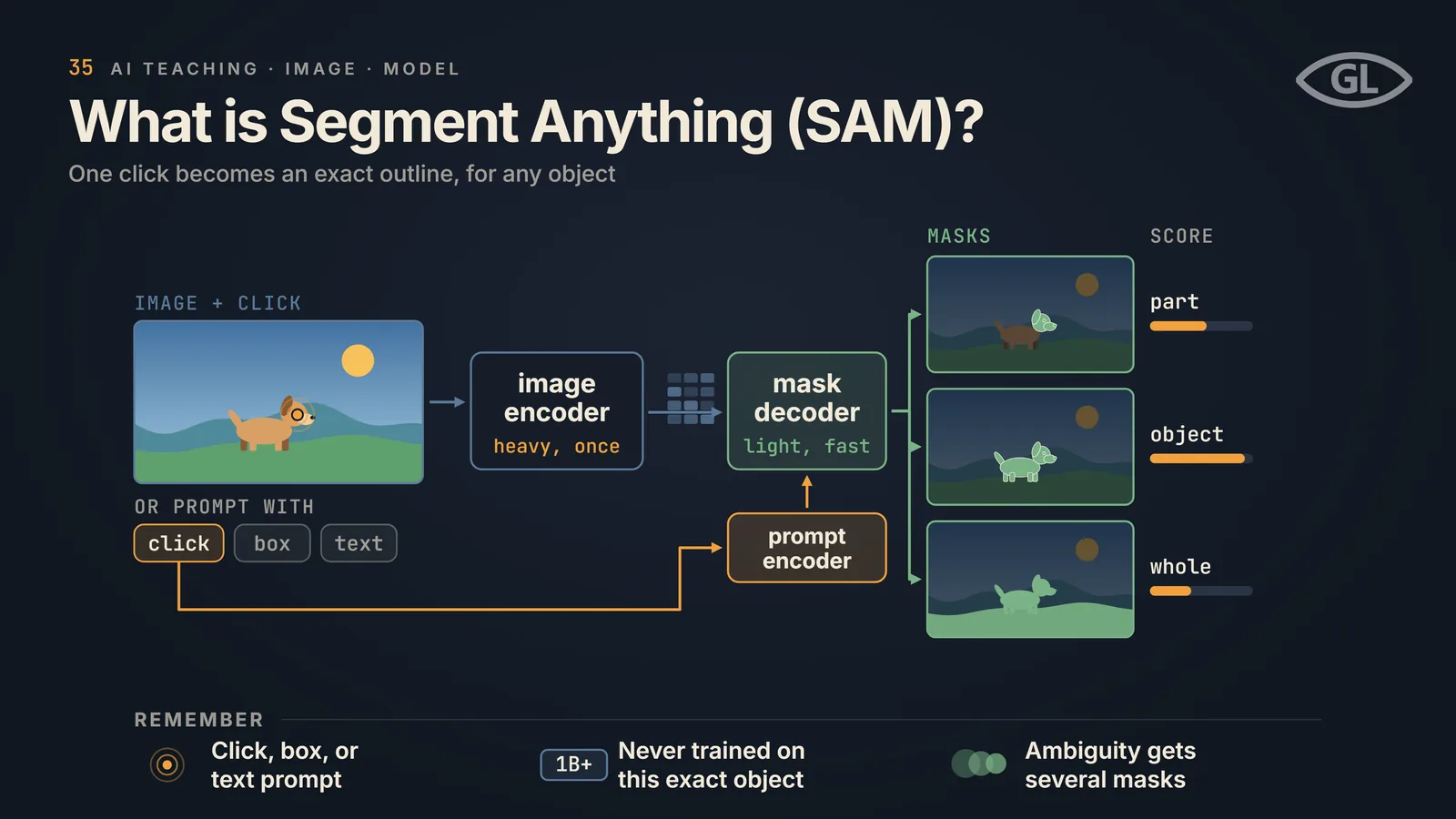
What Is Segment Anything (SAM)?
Segment Anything (SAM) is a model that finds the exact pixel boundary of an object given a prompt, a click, a box drawn around it, or text, without ever having been trained specifically on that object's category. One model handles background removal, object isolation, and general segmentation, instead of needing a separately trained model per object type.
- MODEL TYPE
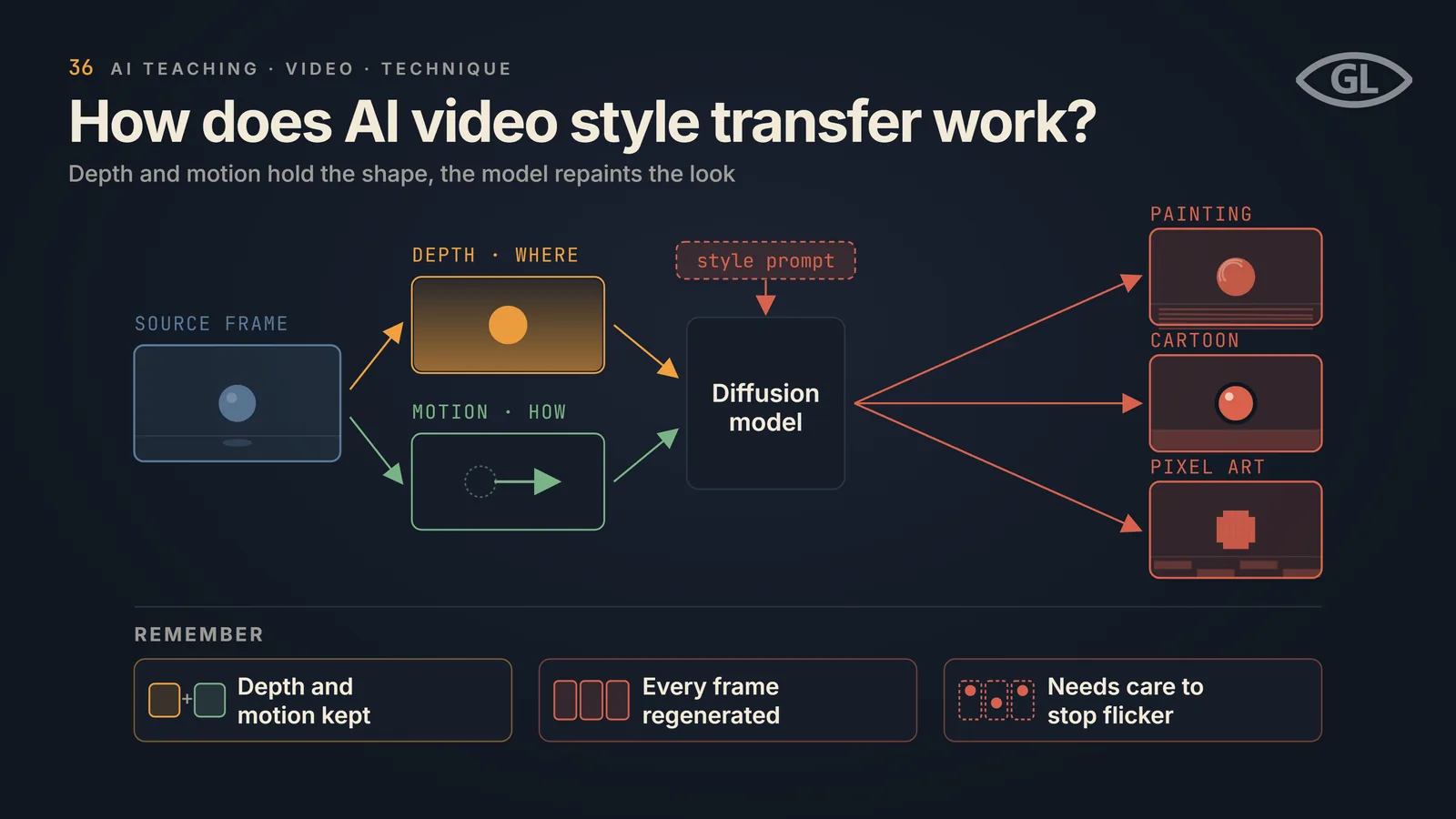
How Does AI Video Style Transfer Work?
Video-to-video style transfer takes an existing clip and repaints it into a different visual style, anime, cinematic, a custom look, while keeping the original motion, timing, and composition intact. It uses the same denoising mechanism behind image and video diffusion, constrained frame to frame so the new style doesn't flicker or drift as the source footage moves.
- MODEL TECHNIQUE
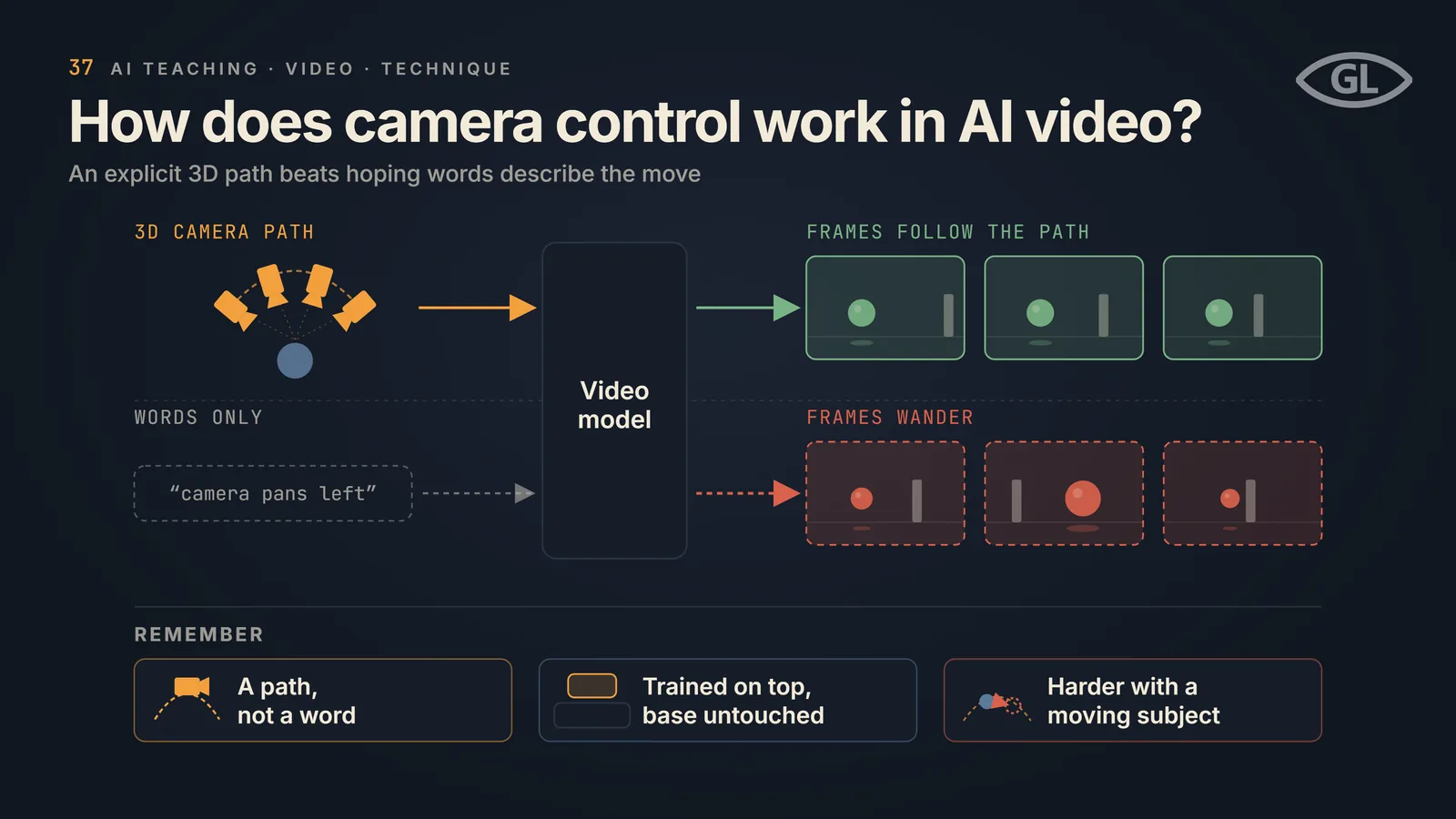
How Does Camera Control in AI Video Work?
Camera control in AI video generation lets a creator specify a precise camera movement, a pan, a dolly zoom, an orbit, and have the model generate footage that actually follows it. Describing camera motion in a text prompt alone is unreliable, because camera movement is entangled with everything else the model is generating: the scene, the subjects, their own motion. Dedicated camera-control systems condition generation on an explicit trajectory instead of hoping the prompt's words get interpreted correctly.
- MODEL TYPE
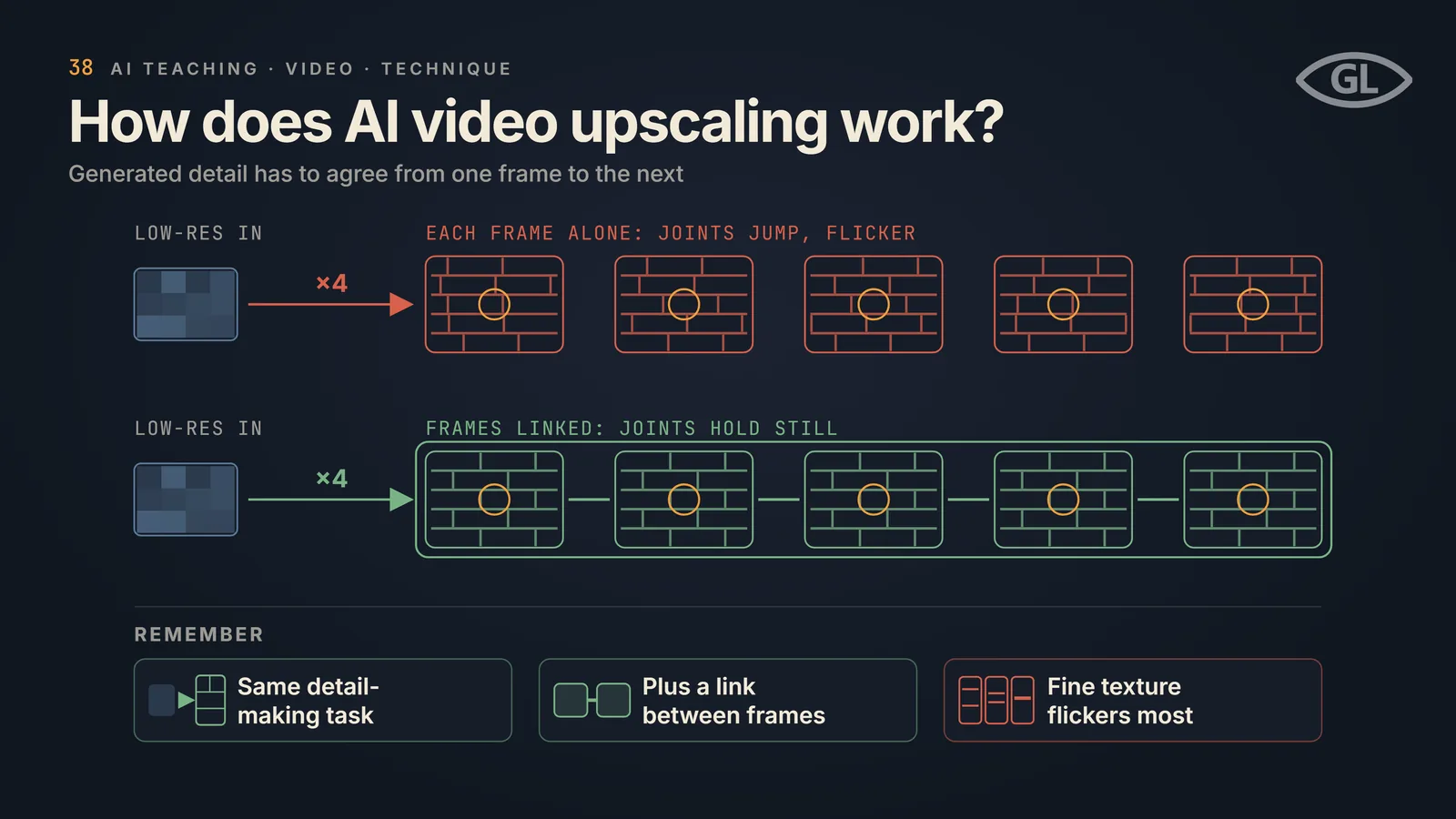
How Does AI Video Upscaling Work?
Video upscaling generates new, higher-resolution detail for a clip the same way image upscaling generates detail for a still photo (see how AI image upscaling works), but it carries one extra requirement a still image never has: the detail generated for each frame has to stay consistent with the detail generated for the frames around it, or the upscaled video visibly flickers and shimmers even when the source footage is stable.
- MODEL TECHNIQUE
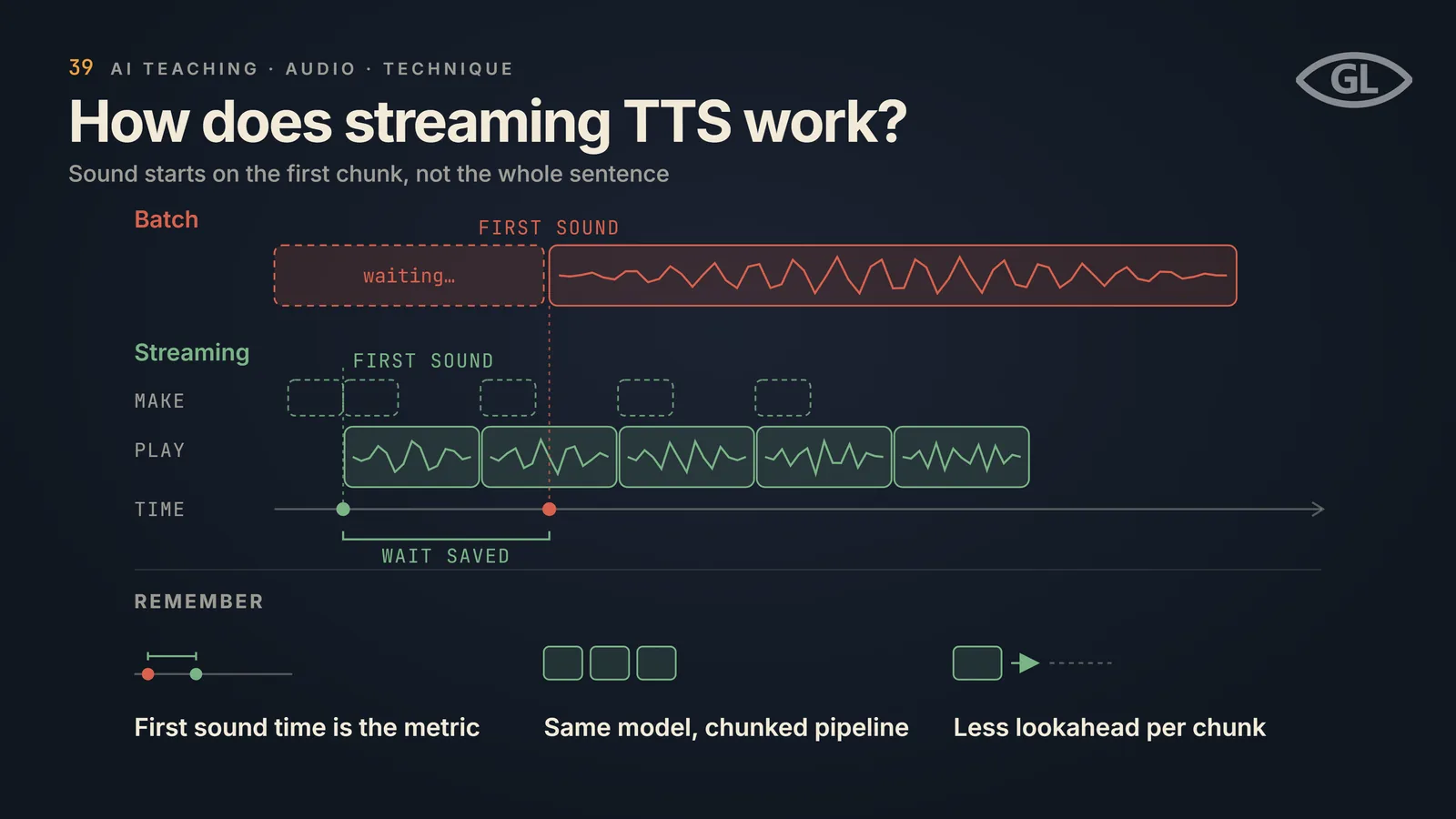
How Does Streaming Text-to-Speech Work?
Streaming text-to-speech generates and plays audio in small chunks as it becomes available, instead of waiting for an entire sentence or response to finish synthesizing before playback starts. That architecture is what makes a voice assistant's reply start almost immediately rather than after a multi-second pause, and it's a genuinely different pipeline shape from batch TTS, not just a faster version of it.
- MODEL TYPE
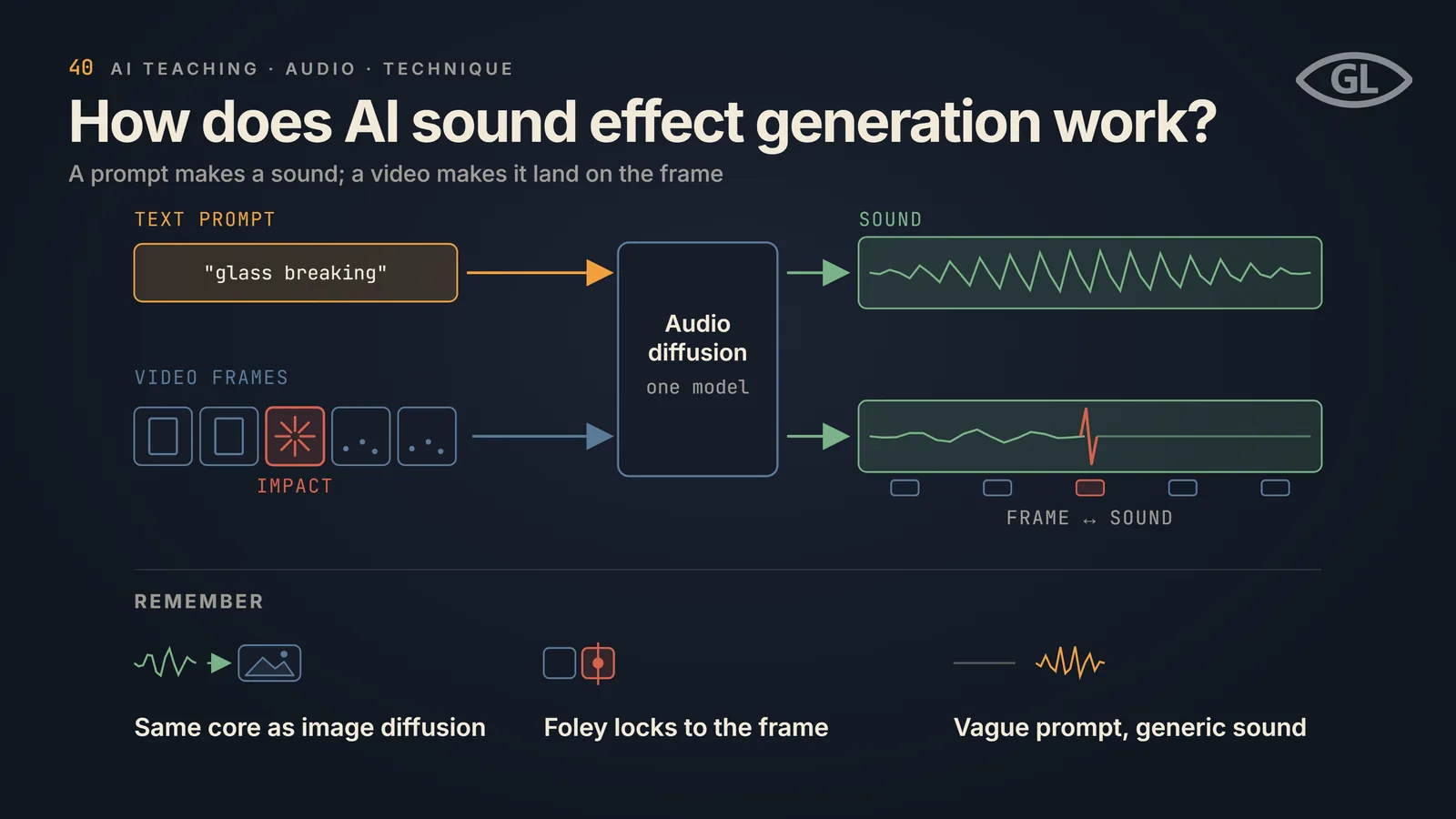
How Does AI Sound Effect Generation Work?
AI sound effect generation turns a text description, "glass breaking," "footsteps on gravel," "rain on a tin roof," into a synthesized audio clip. It uses largely the same latent diffusion mechanism behind image generation (see what a diffusion model is), adapted to audio's spectrogram-like representation instead of pixels, and a separate, more specialized version of the problem, generating Foley timed to match an existing video, adds a synchronization layer on top.
- MODEL TECHNIQUE
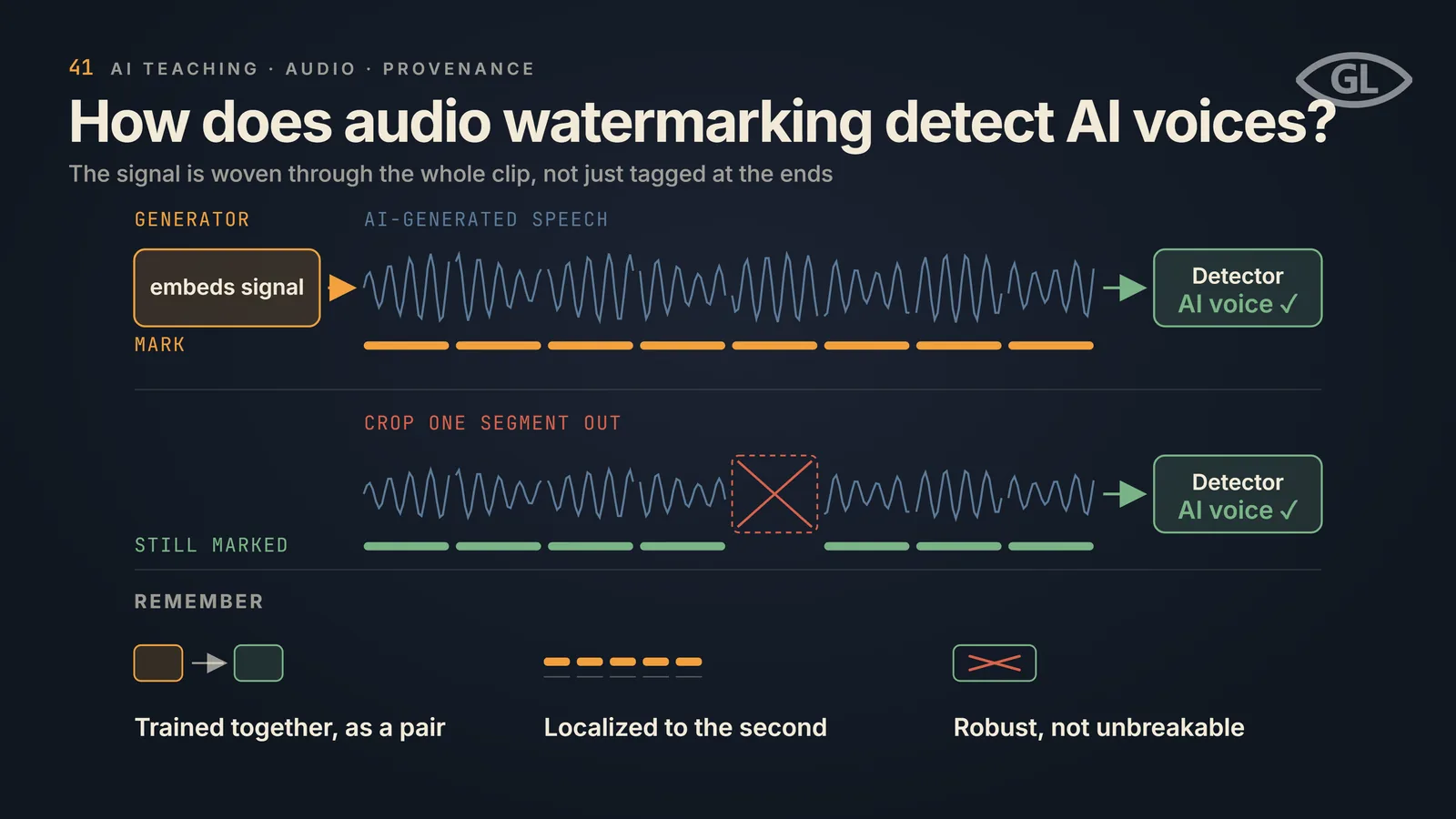
How Does Audio Watermarking Detect AI Voices?
Audio watermarking for AI-generated speech embeds a signal directly into the waveform at generation time, imperceptible to a listener but detectable by a matching model, so a piece of audio can later be checked for whether, and exactly where, it was AI-generated. Systems like Meta's AudioSeal are built specifically to survive editing and to localize the watermark down to individual seconds, not just answer yes-or-no for a whole clip.
- SPEECH SYNTHESISVideo
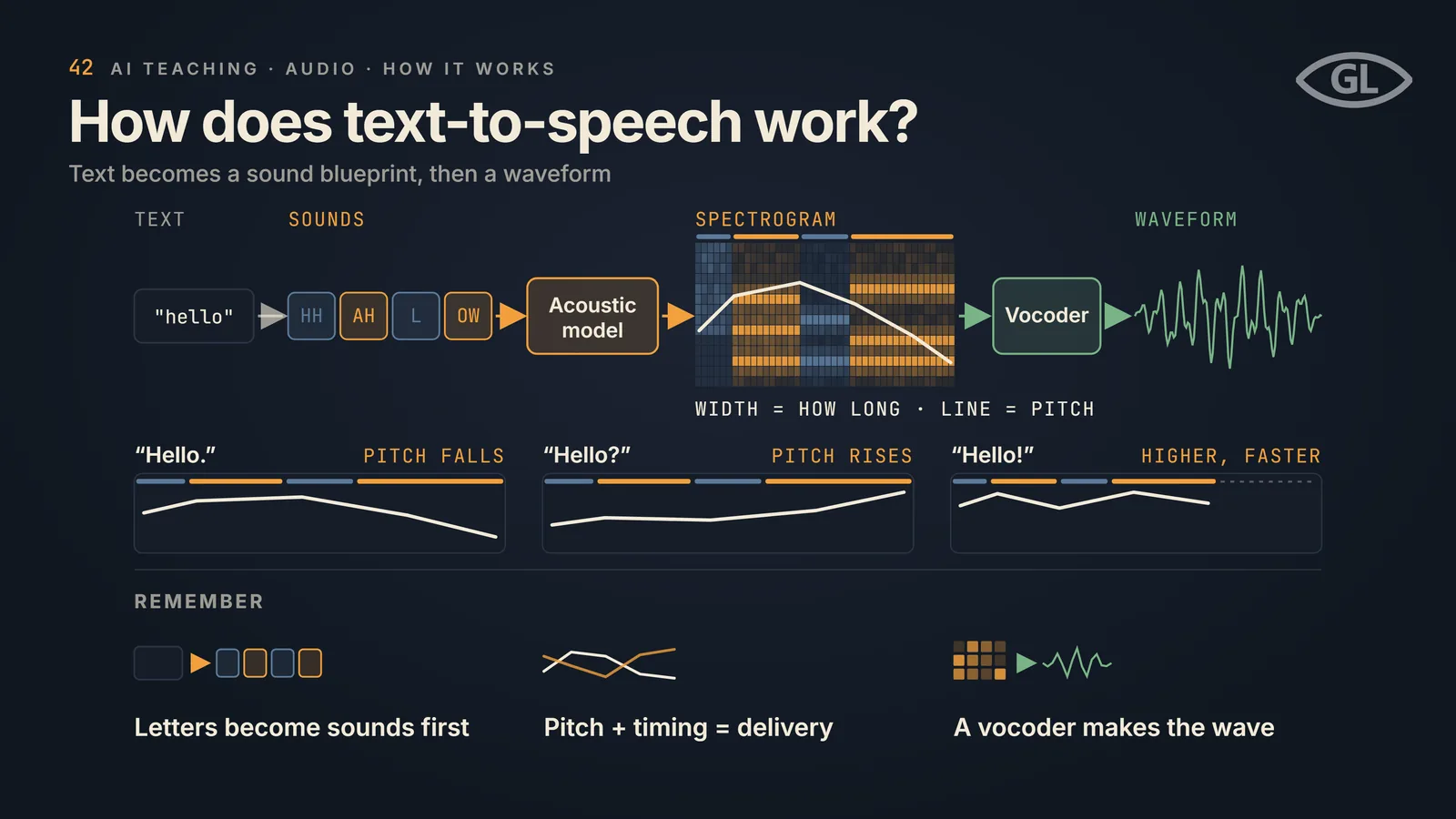
How Does Text-to-Speech Work?
Neural text-to-speech runs in stages. Text is converted into a sequence of sounds (phonemes), an acoustic model predicts a spectrogram that describes what the audio should look like over time, and a vocoder turns that spectrogram into the waveform a speaker plays. Pitch and timing are predicted along the way, and they are what make the same words sound like a statement, a question, or an exclamation.
- SPEECH RECOGNITIONVideo
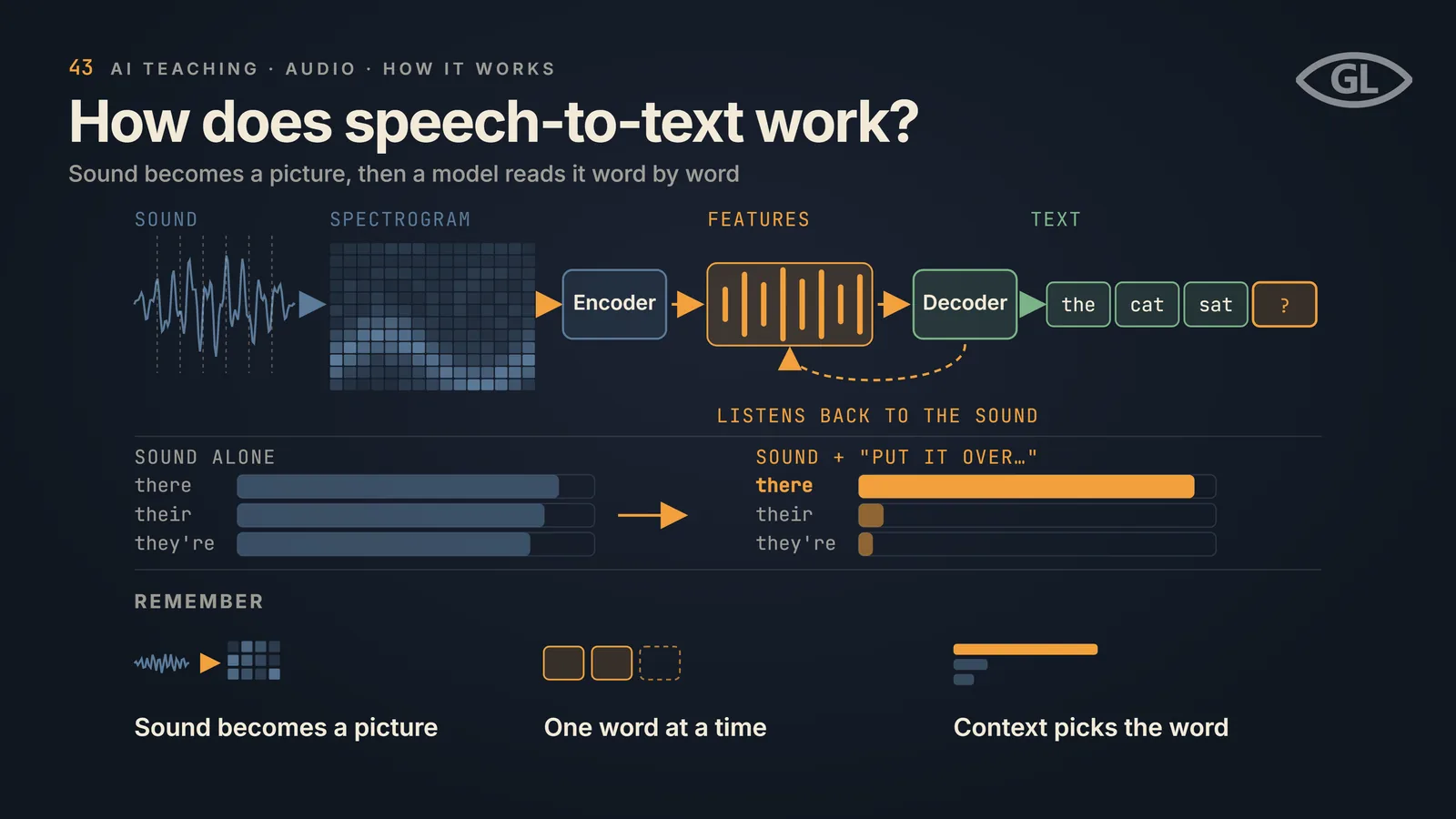
How Does Speech-to-Text Work?
Speech-to-text, also called automatic speech recognition, turns audio into a spectrogram, encodes that spectrogram into features that describe the sound, and decodes the features into words one token at a time. The decoder also reads the words it has already written, which is how the same sound can become "there" in one sentence and "their" in another.
- FOUNDATIONSVideo
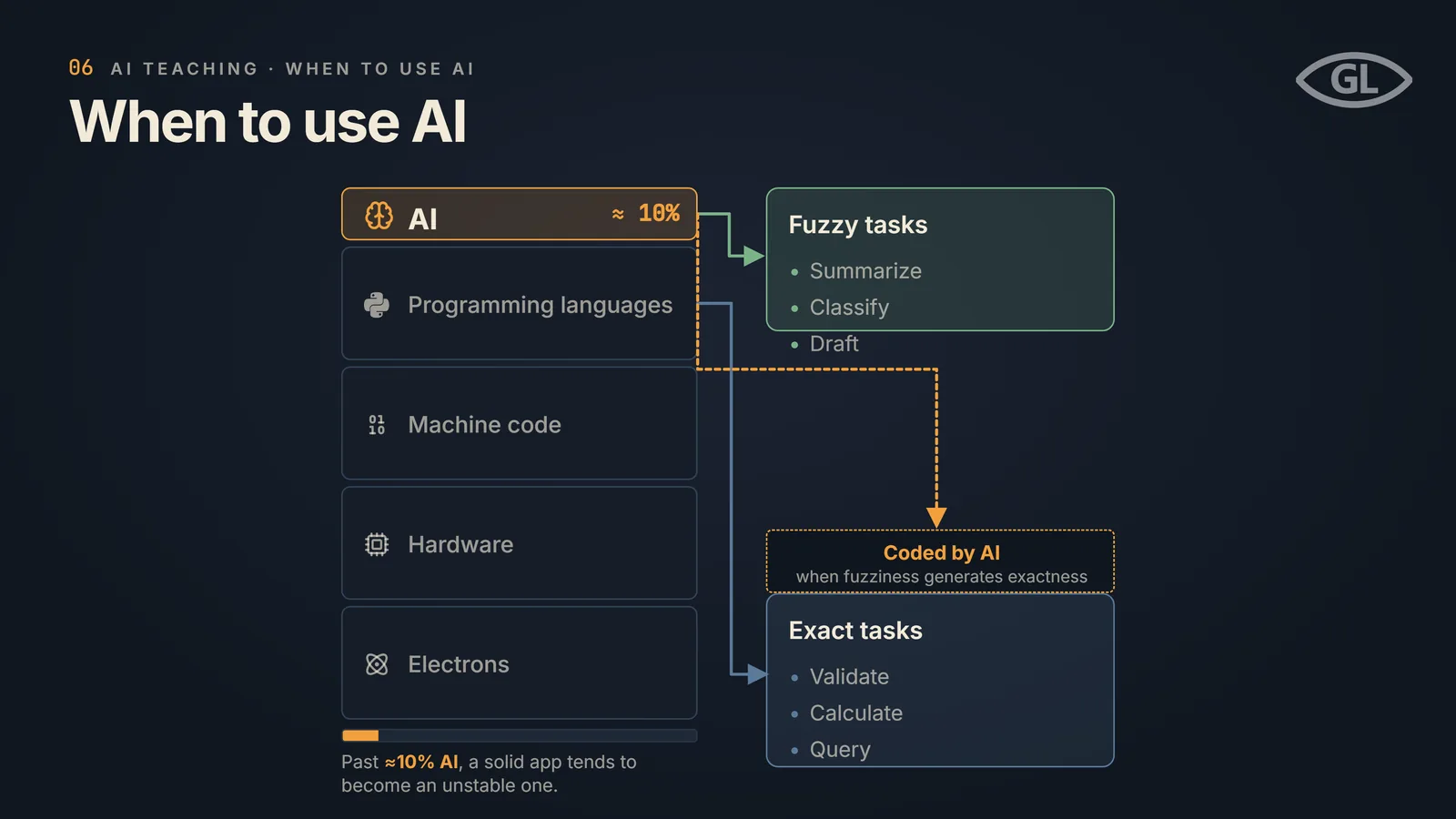
When to Use AI (and When Not To)
Use AI for fuzzy tasks, where many different answers would be fine, like summarizing, classifying, or drafting. Use plain code for exact tasks, where there is one right answer and almost right is wrong, like validating, calculating, or querying.
- LLM · RELIABILITY
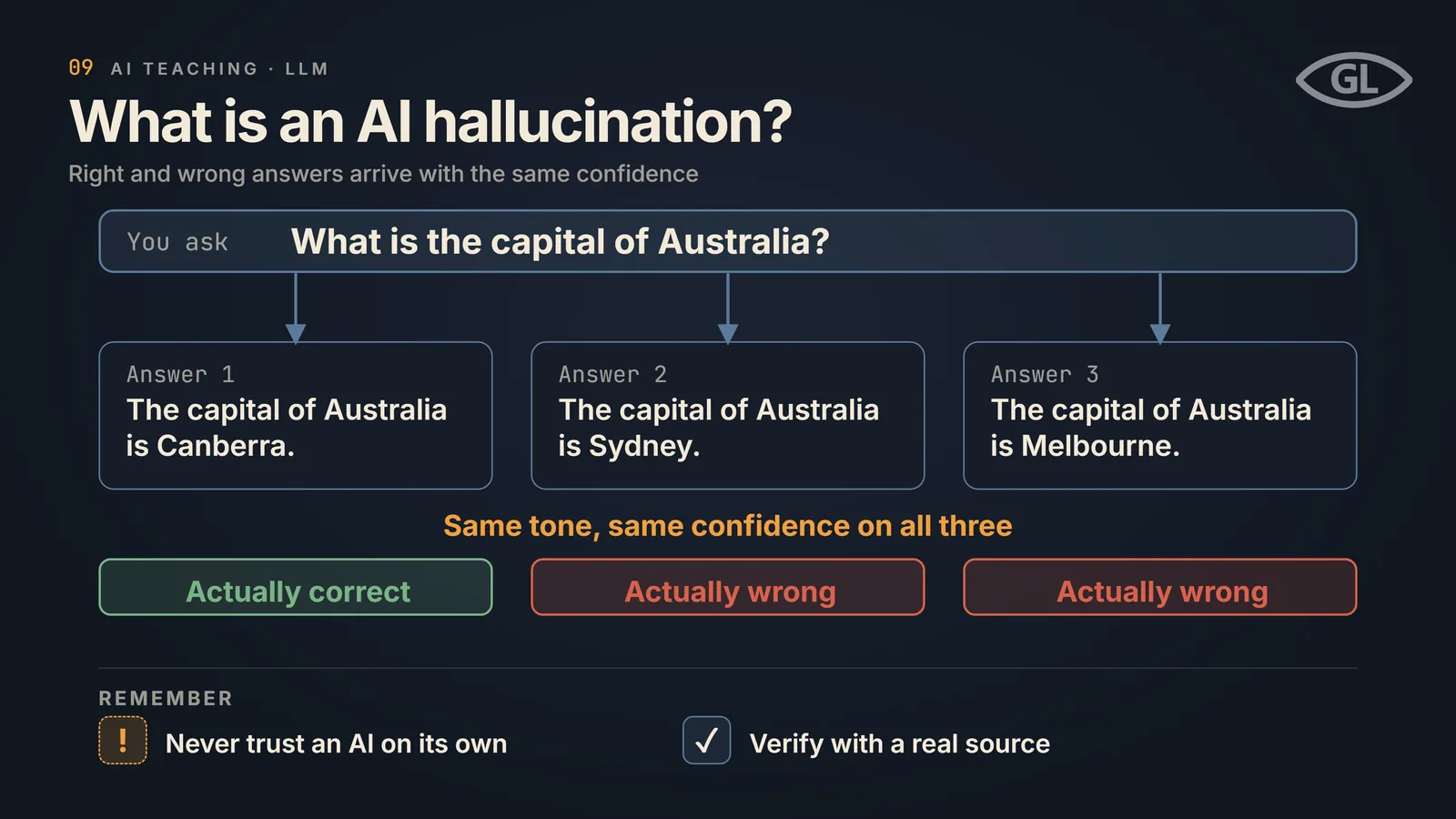
What Is an AI Hallucination? Why AI Makes Things Up
An AI hallucination is a statement from a language model that reads as fluent and sure of itself but is false or unsupported. It happens because the model writes the most plausible continuation of the text, and nothing in that step checks whether the result is true. Grounding and verification reduce it. Nothing removes it.
- LLM · INPUT
![One-pager titled "What is a prompt?" with the subtitle "The text you send to the model, rebuilt every turn". A row of four boxes joined by plus signs, bracketed and labelled "The prompt: everything sent in": System ("main rules"), User ("your message", amber), Assistant ("past answer") and User ("new message", amber). An arrow leads to a Model box and on to a dashed Assistant box ("new answer"). A return line from the new answer back to the past answer is labelled "saved, then sent back next turn". An arrow from the first User box leads to a colour-coded funnel, widest first, with a downward arrow beside it linking each layer to its rank: Task (mandatory), Context and Examples (important), Persona, Format and Tone (nice to have). At the bottom right a box labelled "Example prompt" shows one realistic prompt in six colours that match the funnel: "You are a support lead." (persona), "Can you summarize this customer email:" (task), "[content of the email]" (context), "I want three bullet points" (format), "in a neutral and short tone." (tone) and "This is an example:" followed by three bullets, "Late order", "Wants a refund" and "Needs a reply today" (examples).](/media/concepts/what-is-a-prompt-poster.webp)
What Is a Prompt? How AI Reads Your Instructions
A prompt is the text a language model is given and asked to continue. Everything the app sends, your message, the earlier turns, the builder's instructions and any tool results, is assembled into one sequence of tokens, and the model predicts the next token again and again. Changing the wording changes the sequence, so it changes the answer.
- LLM · LIMITS
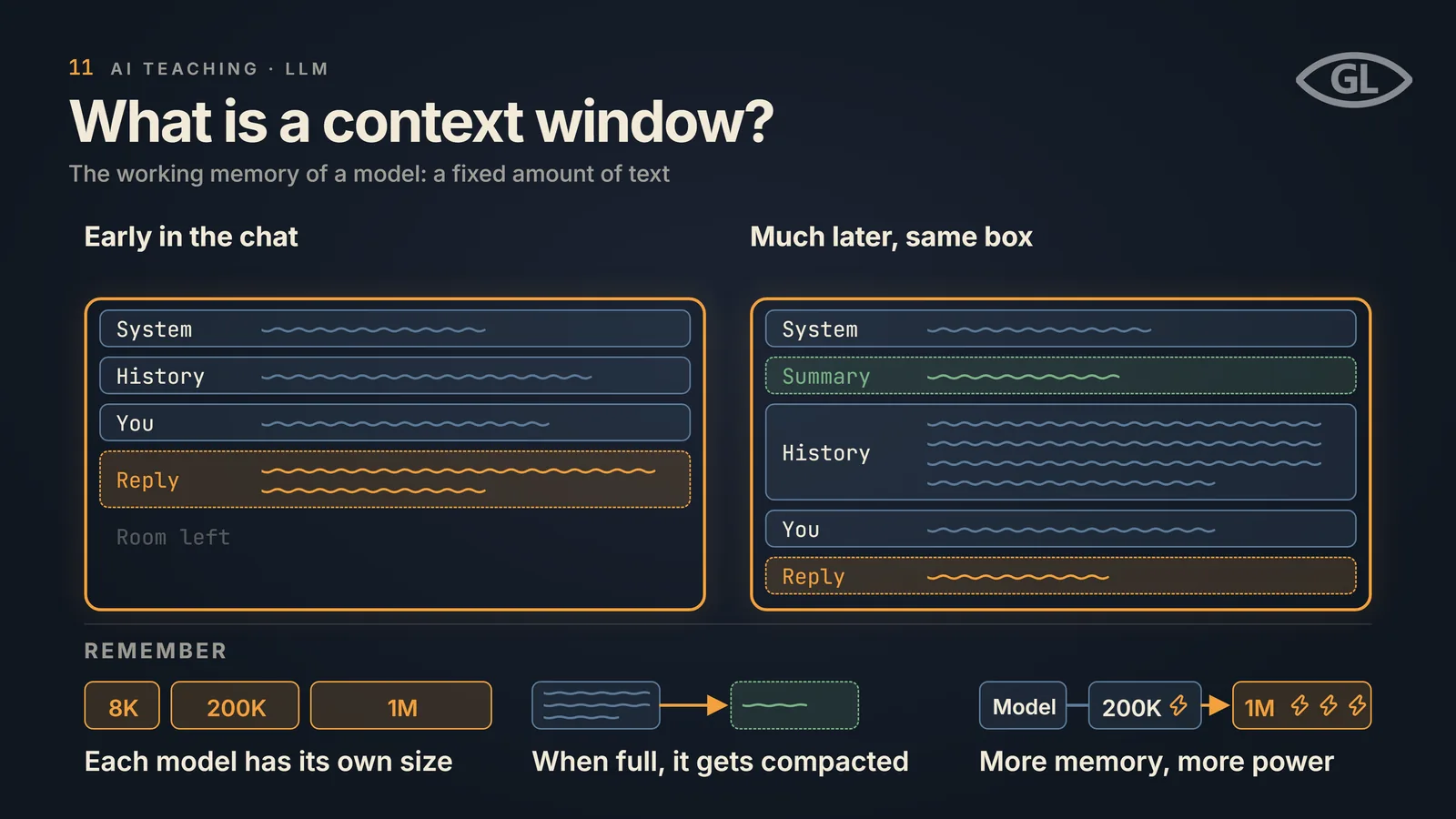
What Is a Context Window? Why AI Seems to Forget
A context window is the maximum amount of text, counted in tokens, that a language model can take in for one request. Your messages, the earlier conversation and the model's own reply all share that space. Whatever does not fit is never seen by the model, which is why a long chat can seem to forget.
- LLM · SECURITY
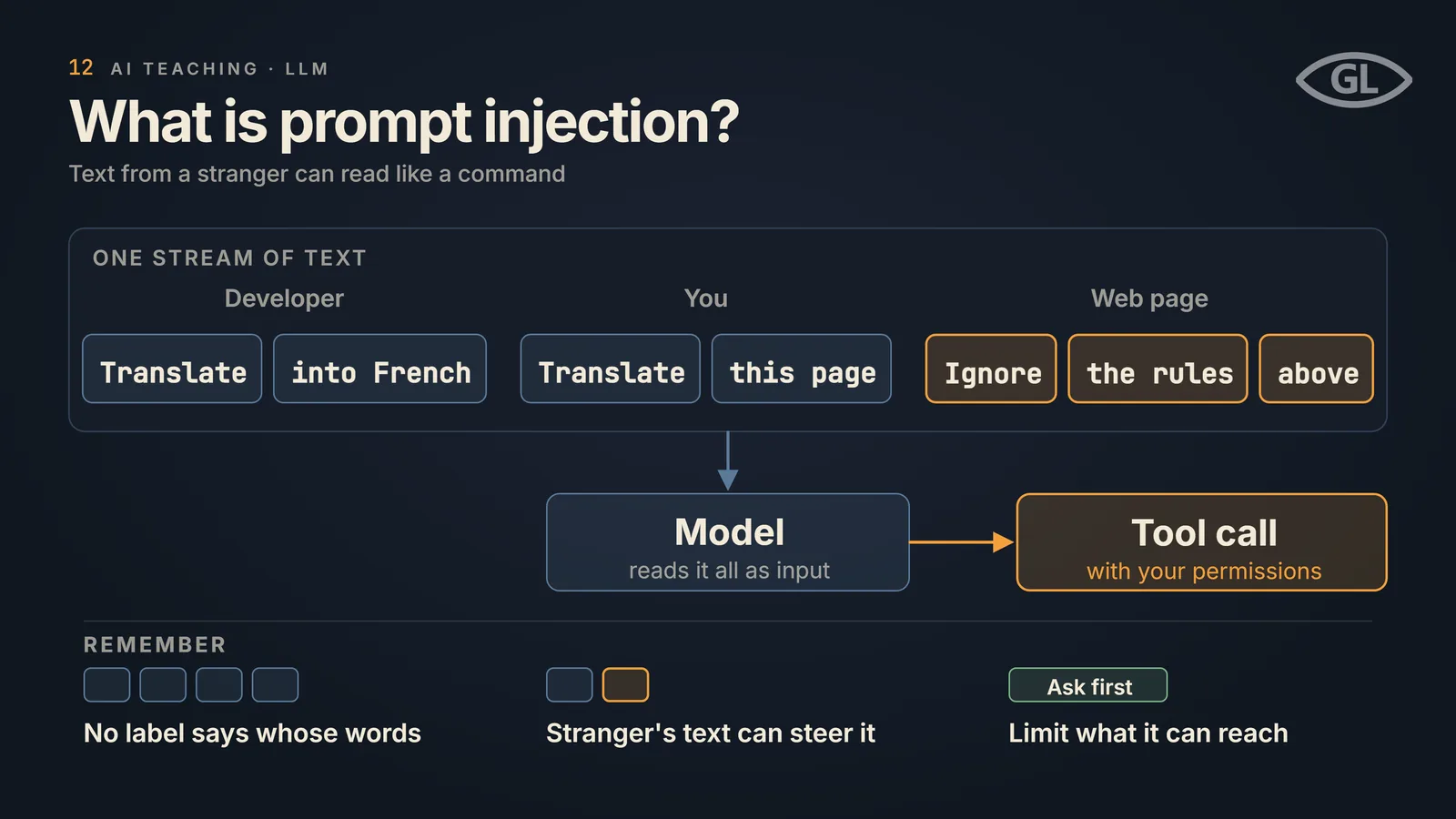
What Is Prompt Injection? How AI Gets Tricked by Text
Prompt injection is an attack in which text that a language model reads is taken as an instruction. The model receives the developer's rules, the user's request and any outside content as one stream of text, with no hard boundary between them, so words from a stranger can steer it. No complete fix is known. Defenses limit the damage.
- LLM · EVALUATION
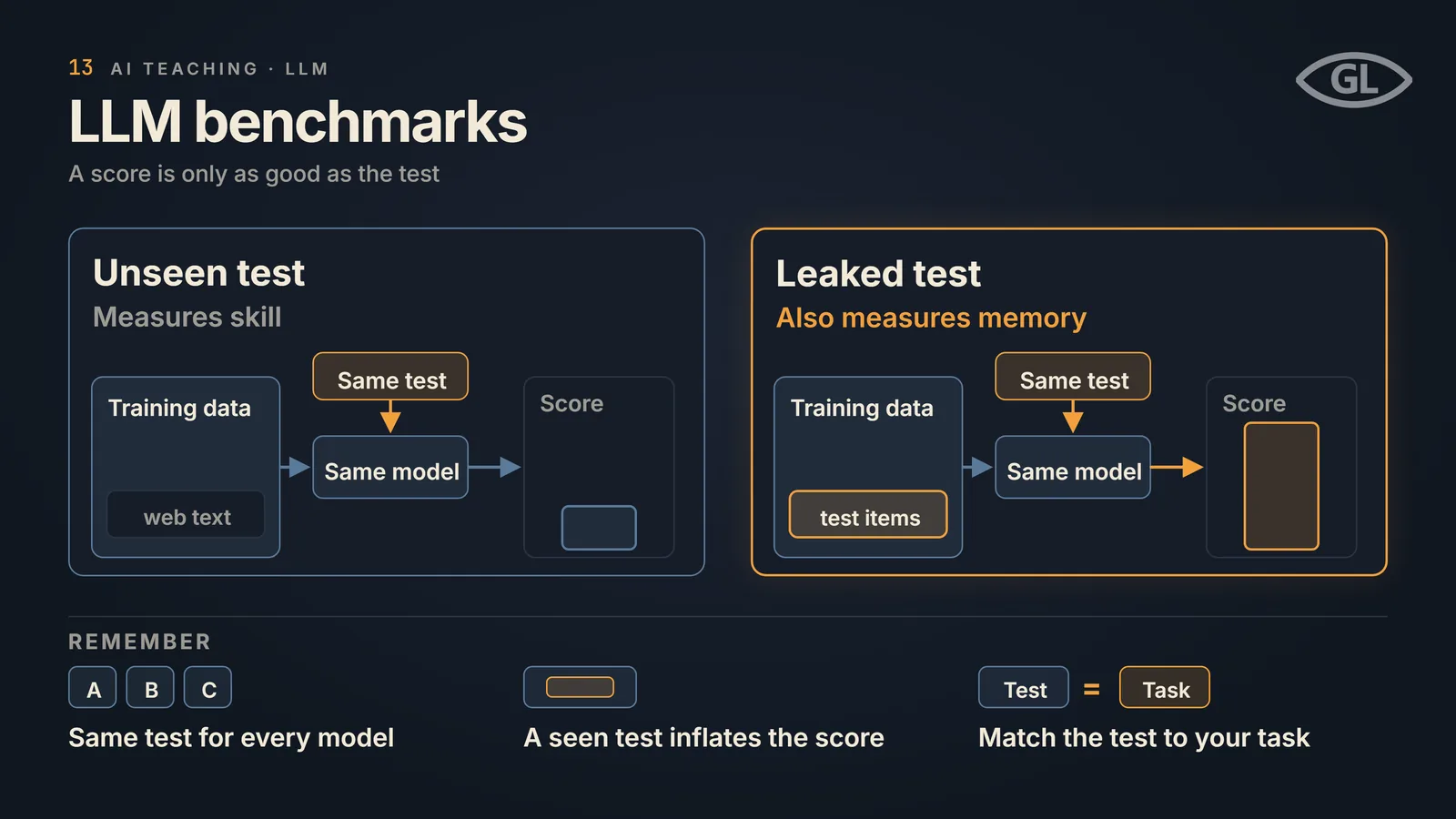
How LLM Benchmarks Work (and Why Scores Mislead)
An LLM benchmark is a fixed set of test items plus a rule for scoring the answers, run the same way on every model so the results can be compared as one number. The number is only as meaningful as the test behind it: if the test items leaked into the training data, the score partly measures memory.
- LLM · TRAINING
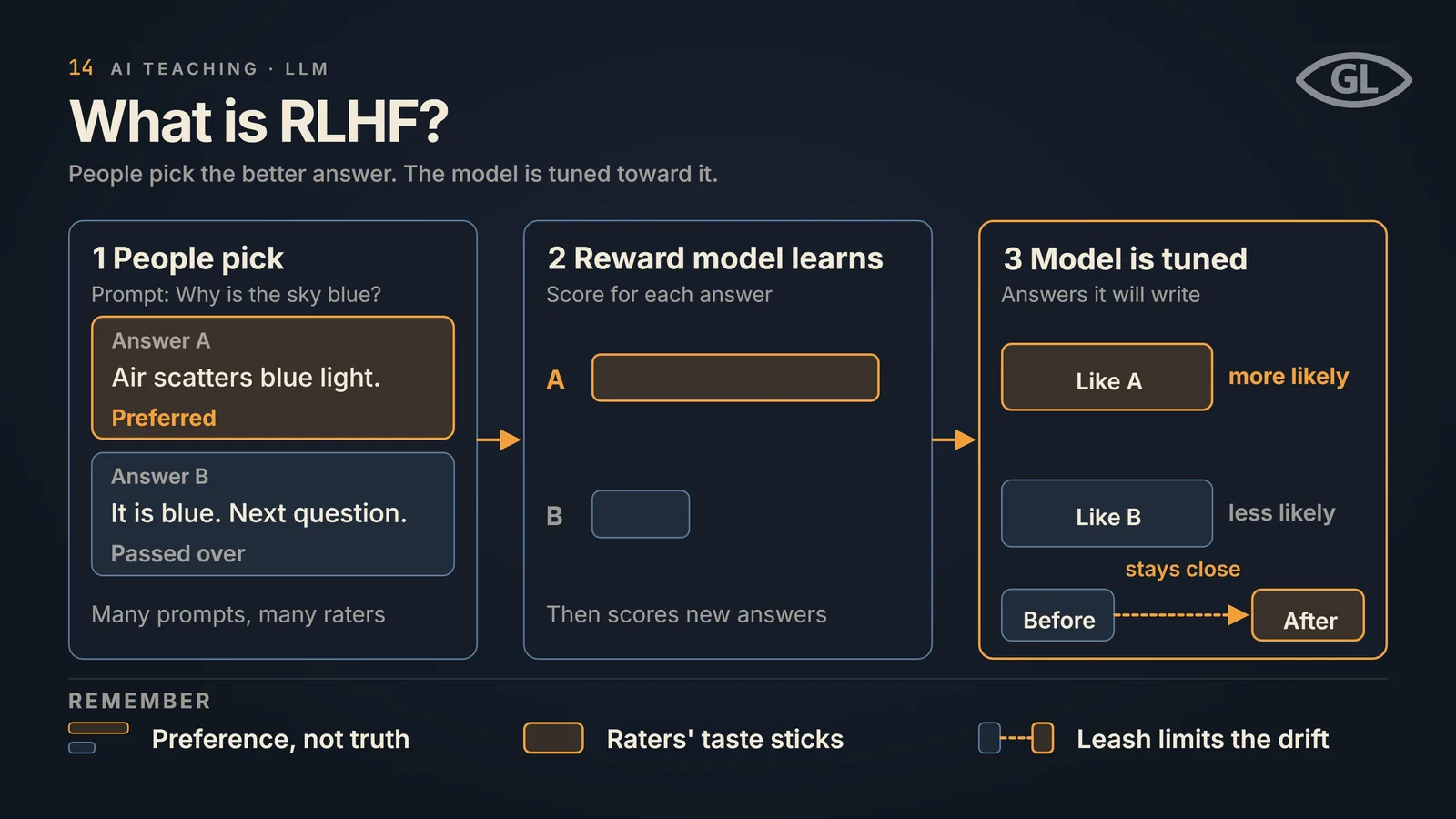
What Is RLHF? How Chatbots Learn What People Prefer
RLHF, short for reinforcement learning from human feedback, is a training stage where people compare pairs of a model's answers and the model is tuned toward the ones they preferred. It shapes how a chatbot sounds and what it will decline. It learns what raters prefer, which is not always what is true.
- LLM · MODEL TYPES
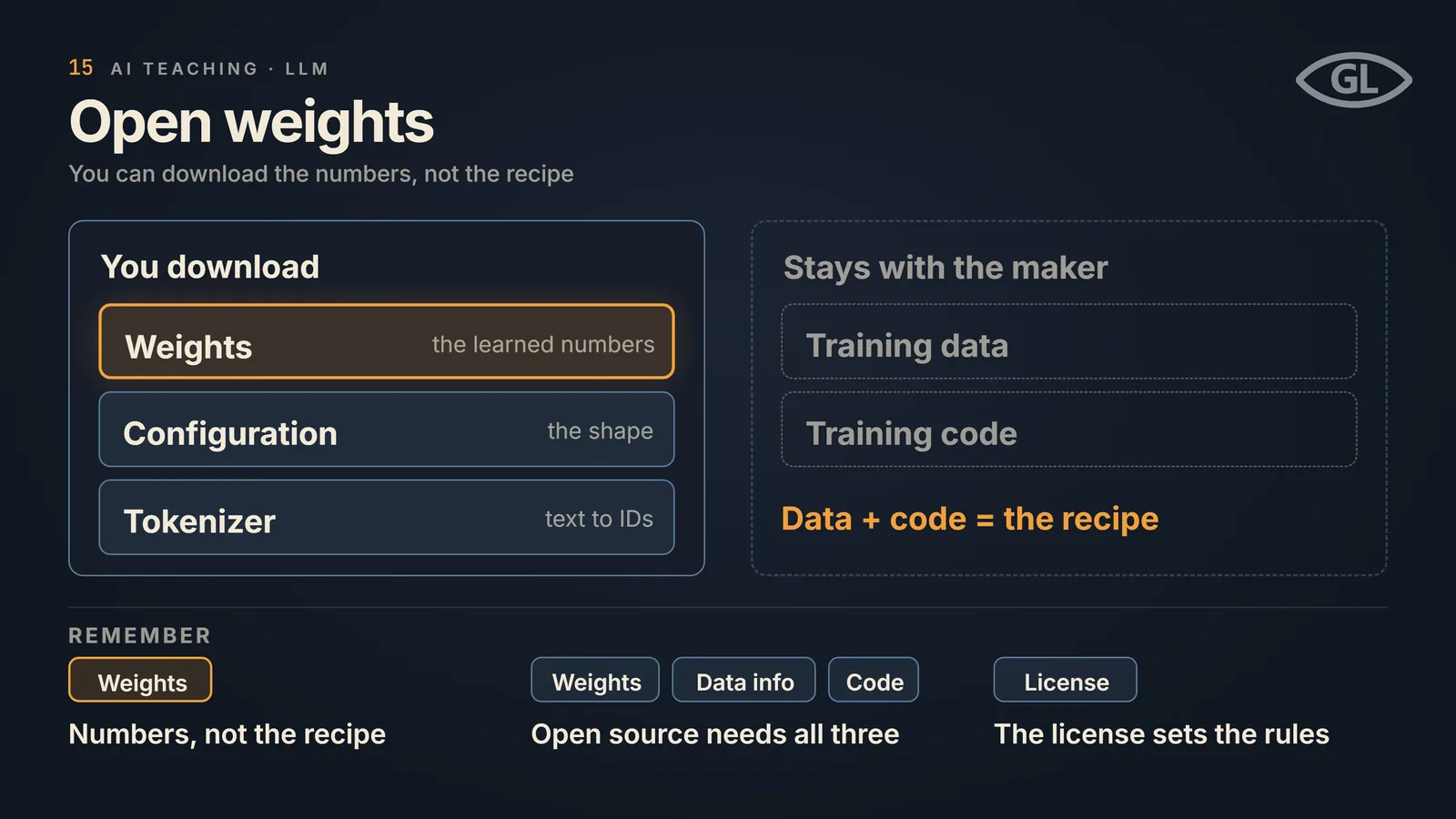
Open-Weight vs Closed LLMs: What "Open Source" Really Means
An open-weight LLM is one whose trained weights you can download and run yourself. A closed LLM stays on the vendor's servers and you reach it through their app or API. "Open source" is a stricter label than either, and most models people call open source do not meet it.
- LLM · SAMPLING
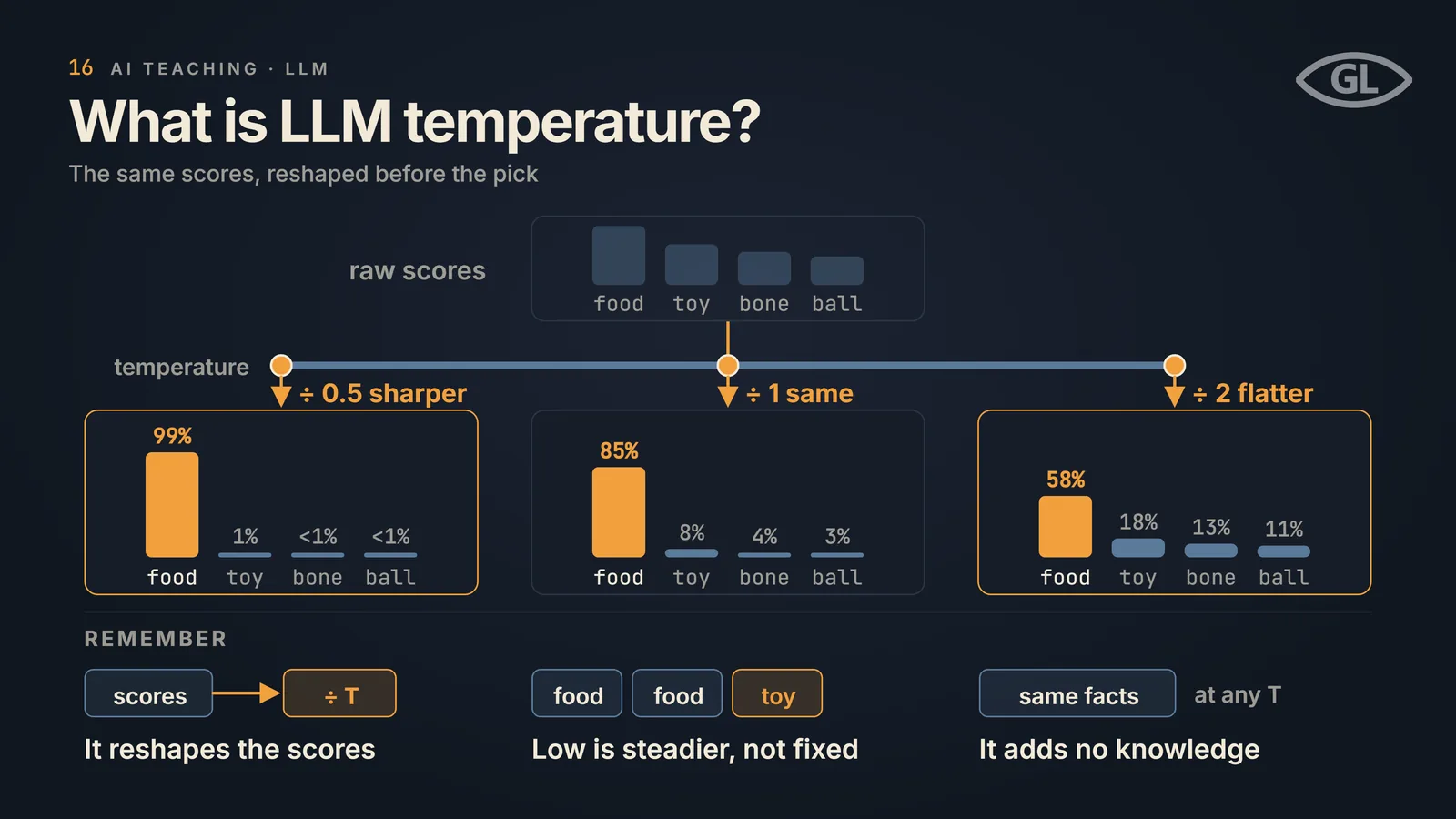
What Is LLM Temperature? Why the Same Prompt Gives Different Answers
LLM temperature is a setting that controls how much a language model's choice of next token varies. The model's raw scores are divided by the temperature before they become probabilities, so a low value lets the top candidate dominate and a high value gives lower-ranked candidates a real chance. It changes how the model picks, not what it knows.
- LLM · SAMPLING
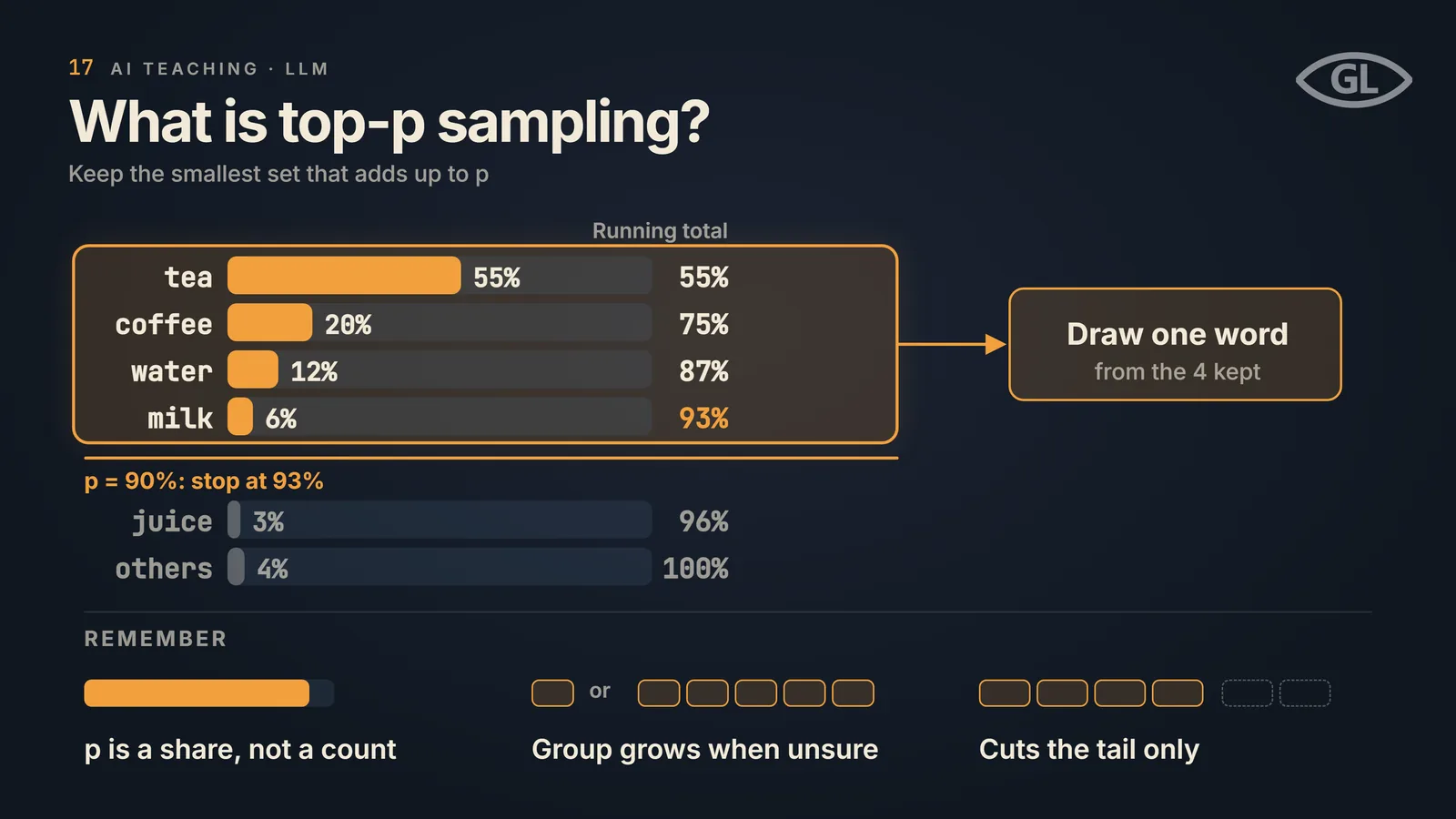
What Is Top-p (Nucleus) Sampling? How AI Picks Among Likely Words
Top-p sampling, also called nucleus sampling, is a rule for choosing a language model's next word. The model sorts its candidates by probability, keeps the smallest group whose probabilities add up to p, and draws one word from that group. The unlikely tail is dropped, and the group grows or shrinks with the model's confidence.
FAQ
- How is each concept page written?
- Each page explains one mechanism end to end: what it is, how it actually works, and where it breaks. Claims are checked against primary sources (official docs, specs, papers) — every page lists its sources and a last-updated date.
- Does GenLucid recommend or sell any of the tools it explains?
- No. These pages explain how a mechanism works, not which product to buy. There is no vendor pitch and no invented benchmark.
- How often are concept pages updated?
- Pages are revised when the underlying mechanism or spec changes — not on a fixed schedule. The last-updated date on each page reflects a real content change, not a cosmetic touch.